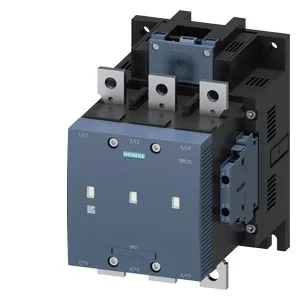
The vacuum arc-quenching technology means the contacts are sealed in a vacuum chamber, eliminating contact erosion from arcing in air — this is the main reason you see it specified for heavy-duty cycling applications like conveyors, crushers, or compressor stations where a standard air-break contactor would wear out faster.
The magnet coil is rated 200... 277 V AC/DC and uses screw-type terminals. The coil holds at 0.8 of rated value and the full-scale inrush is 1.1 times nominal — expect a brief current spike on closure, sized for a standard control transformer.
Auxiliary Contacts and Switching Capacity
An auxiliary switch is included. Its rated breaking capacity varies by voltage: 10 A at 24 V, 2 A at 48 V, 2 A at 60 V, and 1 A at 110 V. These are the maximum continuous currents the aux contacts can interrupt at those DC voltage levels — important when feeding PLC inputs or relay coils downstream.
Duty Cycles and Mechanical Life
Maximum operating cycles per hour depend on the duty class: 800/h under AC-1 (resistive), 300/h under AC-2 (slip-ring motors), 750/h under AC-3 (squirrel-cage motors — start, run, stop), and 250/h under AC-4 (plugging, inching, reversing). The AC-3e rating matches the AC-3 figure at 750/h. Typical mechanical life is 10,000,000 operations — that's the contactor mechanism itself, not the electrical endurance under load.
Fastening is by screw fixing with a single 11 mm diameter hole. The main power terminals accept stranded cable from 70 to 240 mm²; the coil and aux terminals accept solid or stranded wire in ranges 2x (0.5... 1.5 mm²), 2x (0.75... 2.5 mm²), max. 2x (0.75... 4 mm²).