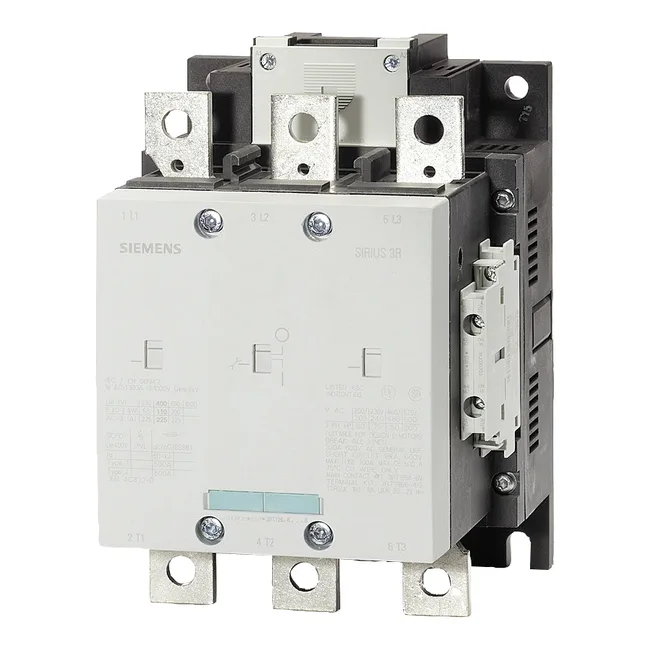
The vacuum arc-quenching technology means the contacts wear slowly even under heavy inductive loads, making it a fit for applications like compressor or pump cycling where mechanical life is the limiting factor. The contactor occupies a 210 mm height, 145 mm width, and 206 mm depth footprint, and mounts via screw fixing on a vertical surface with ±22.5° rotation tolerance. The S10 frame is a common size in the SIRIUS line, so panel cutouts and busbar layouts designed for other S10 contactors will accept this unit without mechanical rework.
The coil is rated 380–420 V AC, with a pickup range of 0.8 to 1.1 times rated voltage. That means the coil will reliably pull in at 304 V and must not see sustained overvoltage above 462 V. The main pole conductors accept stranded cable from 70 to 240 mm², so this contactor can handle the full current range of the S10 frame without needing adapter lugs. Auxiliary contact wiring accepts 2x 0.5–1.5 mm² solid or 2x 0.75–2.5 mm² stranded, max 2x 4 mm² — standard for control circuit terminations. Clearance distances are specified: 10 mm upwards, downwards, and sideways; 20 mm forwards. These are the minimum air gaps required around the arc chamber to prevent phase-to-phase flashover during the 10–15 ms arcing time. If your enclosure is tight, verify these clearances are met before committing the panel layout.
Switching Frequency and Lifecycle Planning
The electrical switching frequency depends on duty class: AC-1 and AC-3 allow up to 750 operations per hour, while AC-2 and AC-4 are limited to 250 per hour. AC-3e, the energy-efficient motor switching class, also permits 750 per hour. The auxiliary switch is rated for 10 A at 24 V, 2 A at 48 V and 60 V, and 1 A at 110 V. These are the make/break capacities for the control circuit — useful when sizing the PLC output or relay that drives the auxiliary load.
The mounting position allows ±22.5° tilt on a vertical surface and horizontal mounting (standing orientation). The power factor at 50/60 Hz is 0.9, which is the load-side power factor the contactor is designed to switch — relevant when coordinating with upstream overcurrent protection.