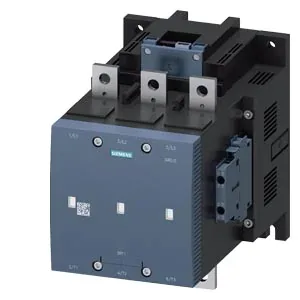
Vacuum arc chamber — what it changes for the panel
The 3RT1275-6NF36: This is a vacuum contactor, not an air-break design. The arc extinguishes in a sealed chamber, so there is no visible contact erosion and no arc chute to clean. Electrical life is typically an order of magnitude higher than an equivalent air-break contactor in the same frame size — relevant for high-cycle applications like crane duty or compressor cycling. Part of the SIRIUS family, Siemens' modular contactor platform for motor control centers and distribution panels. The Size S12 frame determines the panel cutout and mounting hole pattern — 214 mm height, 160 mm width, 225 mm depth. The 225 mm depth is the dimension to check against shallow enclosures.
Coil and control circuit — 96-127 V wide-band
The magnet coil is rated 96-127 V — a single winding that covers 110 V and 120 V control circuits without a tap change. Coil terminals are screw-type, so expect to torque down ring or fork terminals; no push-in or spring-cage on the coil circuit. These are the switching limits for the control circuit, not the main poles — the PLC output or relay feeding the contactor must be rated for the inrush, not just the sealed current. Switching frequency varies by duty class: 750 ops/h in AC-3 (motor starting) and AC-3e, 250 ops/h in AC-2 and AC-4. The AC-4 ceiling (plugging, inching) is the thermal limit of the contactor, not the coil — exceeding it shortens electrical life even if the coil holds in.
Power terminals and mounting — screw-fixed, large cable range
Main power terminals accept 70-240 mm² stranded cable — sized for high-current motor feeds. Mounting is screw fixing with 11 mm diameter holes — not DIN-rail snap-on. Minimum clearance: 10 mm upwards, downwards, and to the side; 20 mm forwards. The operating ceiling limits panel ambient near the contactor — if the enclosure internal temperature exceeds 60 °C, derate or add ventilation.