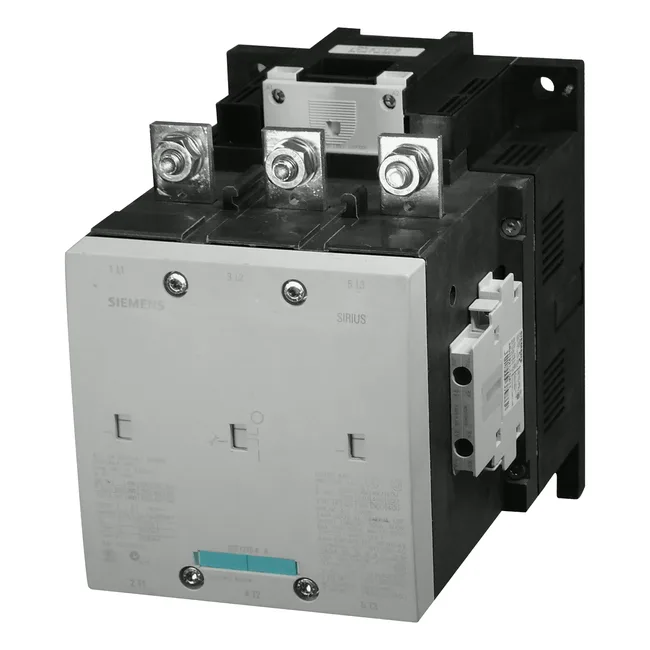
Rated for 440 to 480 V, it handles the common 480 V three-phase distribution voltage found across North American and some European industrial plants. The vacuum switching technology means the arcing time sits at 10 to 15 ms, which keeps contact erosion low. Operating time is 60 to 100 ms on both AC and DC control supplies, so the coil response is consistent regardless of the control voltage type.
Fastening is by screw fixing through a single 11 mm diameter hole, so the contactor bolts directly to a backplate or sub-panel — no DIN rail adapter is used here. Dimensions are 214 mm high, 160 mm wide, and 225 mm deep — verify the gland plate and enclosure depth before laying out the panel.
Wiring and conductor ranges
The main power circuit accepts stranded conductors from 70 to 240 mm² — sized for the full rated current of the S12 frame. The coil and auxiliary terminals are screw-type and accept solid or stranded wire: 2x (0.5 to 1.5 mm²), 2x (0.75 to 2.5 mm²), or a maximum of 2x (0.75 to 4 mm²). An auxiliary switch is built in, rated at 10 A at 24 V, 2 A at 48 V, 2 A at 60 V, and 1 A at 110 V — check the control voltage against these ratings for the aux circuit.
Switching rates and duty cycles
Maximum switching rates per hour: 700 for AC-1 (resistive loads), 250 for AC-2 (slip-ring motors), 750 for AC-3 (squirrel-cage motors, starting only), 250 for AC-4 (plugging/inching), and 750 for AC-3e (enhanced AC-3). The AC-3 rate of 750 operations per hour is the one that governs most standard motor-starting applications — it matches the mechanical capability without thermal overload.