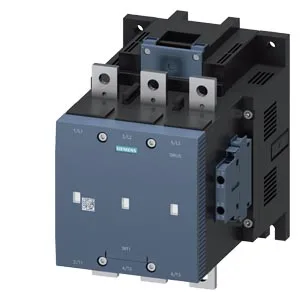
Vacuum contactors are preferred for medium-voltage applications where arc quenching in air is less reliable — the vacuum bottle extinguishes the arc cleanly, reducing contact wear and extending service life. This unit is rated for 575 to 600 V AC, so it fits 575 V or 600 V nominal systems common in North American heavy industrial plants. Mechanical life is rated at 10,000,000 operations typical, and the contactor can handle up to 750 switching operations per hour under AC-3 duty (motor starting). That puts it in the heavy-duty cycling class — suitable for frequent-start applications like conveyors, pumps, and compressors that cycle multiple times per shift.
Mounting and wiring reality
Mounting is screw fixing — no DIN rail snap-on here. The contactor measures 214 mm high, 160 mm wide, and 225 mm deep. That depth (225 mm) is the dimension that matters most when laying out the gland plate and door clearance: you need at least that much space behind the panel door plus room for the incoming cable bend radius. Power wiring accepts stranded cable from 70 mm² up to 240 mm² — that's substantial copper, sized for the full rated current at 575-600 V. Auxiliary control wiring uses screw-type terminals on the magnet coil, accepting 2x (0.5 to 1.5 mm²) solid or 2x (0.75 to 2.5 mm²) stranded, max 2x (0.75 to 4 mm²). The auxiliary switch is present (yes), so you get a feedback contact for the PLC or safety circuit without adding an external block.
The 575-600 V AC rating tells you this is a 600 V class device, not a 480 V one — it's built for the higher nominal voltage common in Canadian and US heavy industrial plants (575 V) or 600 V systems. At 24 V DC the auxiliary contact is rated 10 A; at 48 V and 60 V it drops to 2 A. That derating curve matters when you're driving a PLC output or a small control relay — don't assume the 10 A holds at higher control voltages. The storage range is wider because it's a handling limit, not a running one. If this contactor sits in an unheated warehouse in a Canadian winter, -55 °C storage is fine — but it won't start pulling in until it warms above -25 °C.