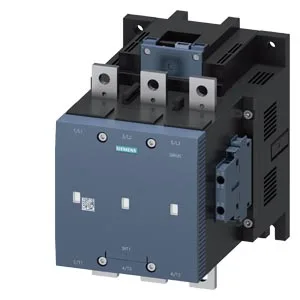
The Siemens 3RT1276-6NP36 is a SIRIUS-brand vacuum contactor in frame size S12. Vacuum contactors are used where the switching arc needs to be contained and extinguished in a vacuum envelope — common on medium-voltage motor starters and transformer switching, where air-break contactors would have trouble with the arc energy. The S12 frame tells you the physical size and the current-carrying capacity of the main poles. The coil is rated for 200-277 V AC/DC, so it lands on a standard 230 V or 277 V control supply without a transformer tap change. The magnet coil uses screw-type terminals, which is the standard termination for this class — no push-in or spring-cage on the coil circuit. Main circuit wiring accepts stranded cable from 70 mm² up to 240 mm², sized for the bolted connection on the S12 pole. Auxiliary contacts are present, so you get at least one N.O. or N.C. feedback pair built in without an add-on block.
Fastening is by screw fixing, not DIN-rail snap-on. The contactor has a single 11 mm mounting hole — expect to bolt it to a backplate or mounting rail with an M10 or 3/8" bolt. The S12 footprint is 160 mm wide, 214 mm tall, 225 mm deep, so plan for that envelope in the panel layout. That gives you some room to fit it into a tight cabinet, but the 225 mm depth is the dimension to watch when closing the door. These are minimums for arc flash and cooling — don't crowd the enclosure.
Switching performance and duty
This is a vacuum contactor, so the arc is quenched in a sealed vacuum bottle. Arcing time is 10-15 ms, and the coil pick-up and drop-out times are both 80-100 ms on AC or DC. That's a consistent, repeatable switching profile for process interlocks. Switching rates: 700 operations per hour at AC-1 (resistive), 250 at AC-2 (slip-ring motors), 750 at AC-3 (squirrel-cage motors), 250 at AC-4 (plugging/inching). The AC-3 and AC-3e rates are both 750 1/h, so it handles standard motor starting duty cycles well. The AC-4 limit of 250 1/h reflects the heavier arc wear from reversing or jogging. Electrical life will be lower and depends on the switched current and duty class.
The auxiliary contact ratings at 24 V are 10 A, dropping to 2 A at 48 V and 60 V, and 1 A at 110 V. That's a resistive load curve — inductive loads will need derating or a suppression network across the aux contacts.