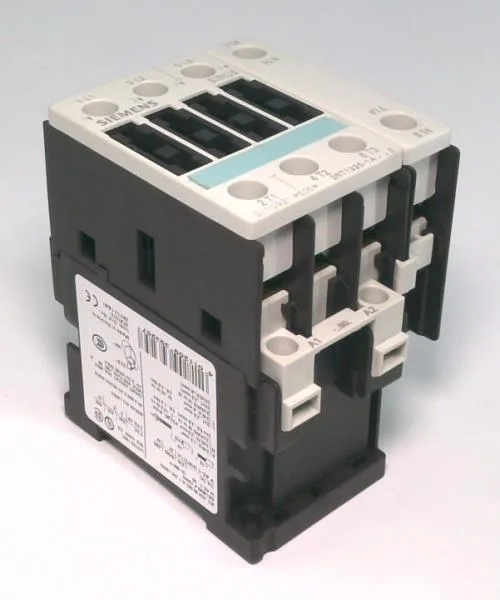
What this SIRIUS S0 contactor brings to the panel
The AC-2 rating at 400 V comes to 7.5 kW, which covers a fair range of three-phase induction motors in the 10 HP ballpark. For the main circuit, wire it with screw terminals accepting up to 2x 10 mm² stranded. Auxiliary contact ratings are given across several control voltages: 10 A at 24 V, 6 A at 230 V, 3 A at 400 V, and down to 0.3 A at 220 V DC. That covers both AC and DC control circuits you'd find in a typical MCC bucket or standalone panel. The auxiliary contacts are built into the contactor, not a bolt-on block. That means it's at home in a non-climate-controlled enclosure on a plant floor.
The 3RT1325-1AH20 has two coordination paths depending on how tight you need the protection. Type 1 coordination (contactor may be damaged but the arc is contained) allows a 63 A gL/gG fuse. Most plant engineers spec Type 2 to avoid pulling a welded contactor out of a live panel. The contactor itself is rated for 10 million mechanical operations typical, so it'll outlast several motor rewinds in moderate-duty cycling. Side-by-side mounting is allowed — no derating gap required between units on the rail. That saves panel width when you're stacking several contactors in a motor control center.
Integration notes — dimensions and wiring
The contactor measures 91 mm deep by 61 mm wide by 85 mm tall. That depth is the critical dimension for enclosure selection — it needs at least 100 mm of clear enclosure depth to allow for wire bending radius behind the terminals. Main circuit wiring accepts 2x (1 to 2.5 mm²) or 2x (2.5 to 6 mm²) stranded, with a maximum of 2x 10 mm². The auxiliary/solid wiring takes 2x (0.5 to 1.5 mm²) or 2x (0.75 to 2.5 mm²) stranded. Use ferrules on stranded wire for reliable screw-clamp connections, especially in high-vibration environments like a conveyor line. Altitude rating is 2,000 m maximum without derating. Above that, you'd need to account for reduced air density affecting arc extinction and dielectric strength. For most plant-floor applications below 1,000 m, it's not a concern.