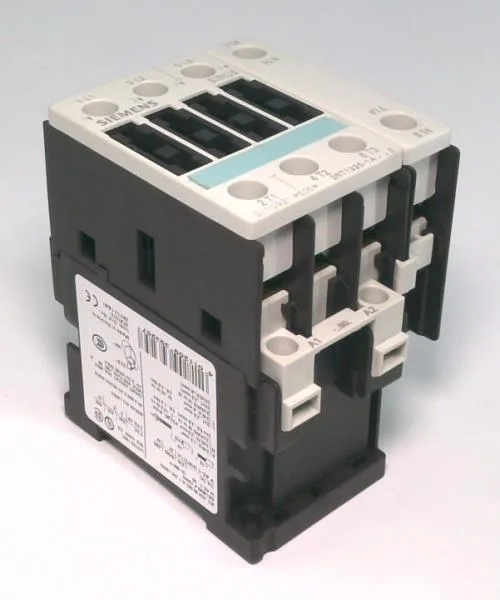
What this contactor is and where it fits
The Siemens 3RT1325-1AN60 is a SIRIUS power contactor in the S0 frame size, built for switching motor loads in control panels. It carries four normally-open main contacts and is rated for AC-2 duty at 7.5 kW on a 400 V line — that covers wound-rotor motors where the starting current stays moderate, typical in crane, hoist, or conveyor applications. The contactor mounts on a 35 mm DIN rail per EN 50022, using either the screw-down or snap-on method, so it drops into a standard panel layout without special bracketry.
Key ratings and what they mean for fit
The headline motor rating is 7.5 kW at 400 V under AC-2 duty — this is the figure that decides whether the contactor matches your motor nameplate. AC-2 covers slip-ring motors with moderate starting currents; if your load is a standard squirrel-cage motor (AC-3), the rating will differ, so verify the duty class against your application. The 4 NO main contact arrangement gives you four independent poles for switching, useful for two-speed motors or separate load groups where you need isolation per phase set. The contactor accepts screw-type terminals on the main circuit, sized for solid conductors from 0.5 mm² up to 4 mm² per clamp, with a maximum of 10 mm² for a single wire. For stranded wire, it handles 1 to 6 mm² per clamp. This covers the typical motor feeder sizes up to around 4 kW at 400 V without needing terminal adapters. The auxiliary contact block is rated for switching at various control voltages: 10 A at 24 V, 6 A at 230 V, and 3 A at 400 V. These are the figures to check when designing the control circuit — the 24 V rating is the one most PLC outputs will drive, and it comfortably handles a typical relay or contactor coil load. The coil operates at 50 Hz with a rated voltage of 200 V, and at 60 Hz it accepts 200 to 220 V. The tolerance band is 0.8 to 1.1 times nominal at 50 Hz, and 0.85 to 1.1 at 60 Hz, so the coil holds in through typical line sags down to about 160 V at 50 Hz.
Environmental and mounting constraints
The contactor operates from -25 °C to +60 °C, which covers most indoor panel environments including unheated warehouses. The front face is rated IP20 — finger-safe for the operator side of the panel — while the terminal area is IP00, so the contactor must be mounted inside an enclosure that provides the required touch protection. Pollution degree 3 means it tolerates conductive dust and occasional condensation, typical for industrial control rooms. Side-by-side mounting is permitted with a 6 mm gap at the side, so you can pack multiple contactors on a DIN rail without derating, as long as the ambient temperature stays within the limit. The mechanical life is rated at 10 million operations typical, which is standard for the S0 frame and sufficient for most cycling applications. For short-circuit protection, the contactor requires a gL/gG fuse: 25 A for Type 2 coordination (no damage to the contactor) or 63 A for Type 1 coordination (contactor may need replacement after a fault). These are the values to coordinate with your upstream protection device.
