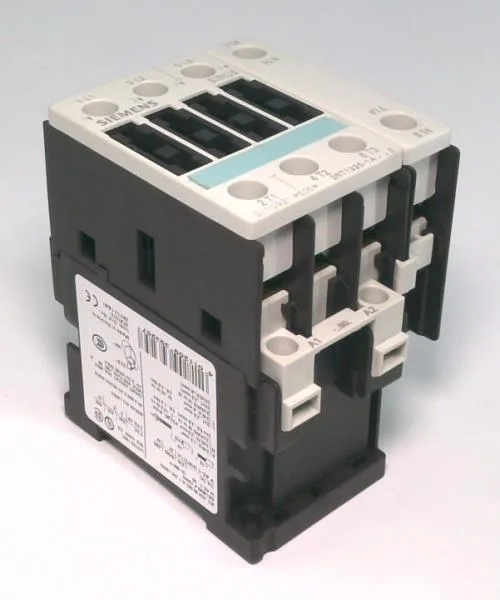
It carries four normally-open main contacts rated for 7.5 kW at AC-2 duty at 400 V — that's the motor-switching curve for slip-ring or wound-rotor motors, so it handles the higher inrush and arcing of those starts. The magnet coil pulls 24 VDC, and it holds at 5.4 W steady-state, which keeps the heat in the panel manageable when the contactor is sealed in. The enclosure face carries IP20 — safe for a closed panel — while the terminal area is IP00, meaning it expects the panel door to provide the final touch-protection barrier.
Short-circuit coordination and wiring
For Type 2 coordination (no welding after a fault) the spec calls for a 25 A gL/gG fuse upstream. For Type 1 coordination (welding allowed, but no fire or shock) it's 63 A. That's a clean choice for the panel builder: if the machine needs to be back online fast after a short, Type 2 with the 25 A fuse keeps the contactor reusable. Main circuit terminals are screw-type, accepting solid 2x (0.5–1.5 mm²) or 2x (0.75–2.5 mm²), with a maximum of 2x (0.75–4 mm²) — fine for the motor leads on a 7.5 kW load. Auxiliary and control circuit terminals are also screw-type, same wire range.