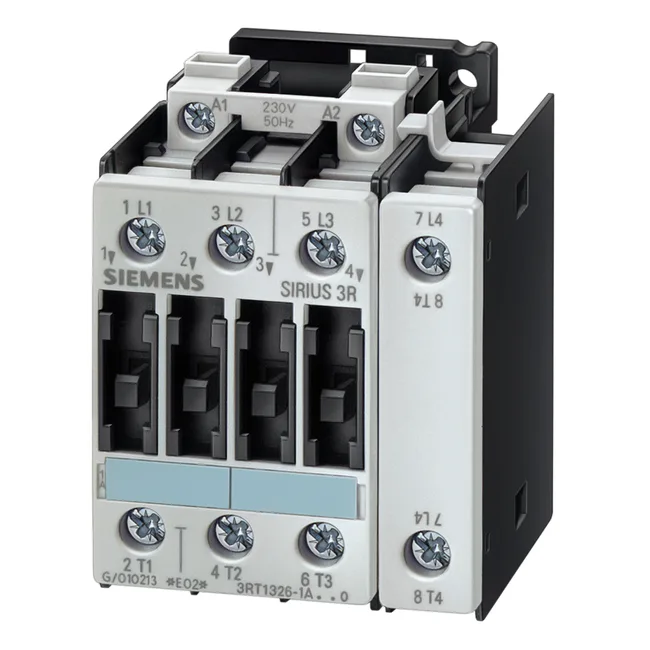
The Siemens SIRIUS 3RT1326-1AN20 is a size S0 power contactor with four normally-open main contacts, rated for motor switching at 11 kW in AC-2 duty at 400 V. That AC-2 rating covers wound-rotor motors and moderate overloads — the kind of load profile you see on conveyors and pumps that cycle under partial load.
That is the load it can switch repeatedly under the moderate inrush of a slip-ring or wound-rotor motor. For AC-3 duty (squirrel-cage motors with higher inrush), the rating will be lower — always check the specific AC-x column when matching to a motor nameplate. The contactor also carries a 10 A rated operational current at 24 V for resistive or lightly inductive control loads. Coil holding voltage is nominal 24 V; the dropout threshold sits below 18 V, which is standard for this class. Main circuit terminals accept solid conductors from 2x 0.5 to 1.5 mm² up to 2x 0.75 to 4 mm², and stranded from 2x 1 to 2.5 mm² up to 2x 2.5 to 6 mm², with a maximum of 2x 10 mm². Dimensions: 85 mm high, 61 mm wide, 91 mm deep. The 61 mm width is the S0 frame standard — it occupies three 18 mm module positions on a DIN rail. Side-by-side mounting is permitted with zero clearance, but the 6 mm side clearance to grounded metal parts must be maintained for arc flash containment.
For Type 2 coordination (contactor remains operational after a fault), the fuse is gL/gG 35 A. These ratings assume a prospective short-circuit current typical of industrial distribution.