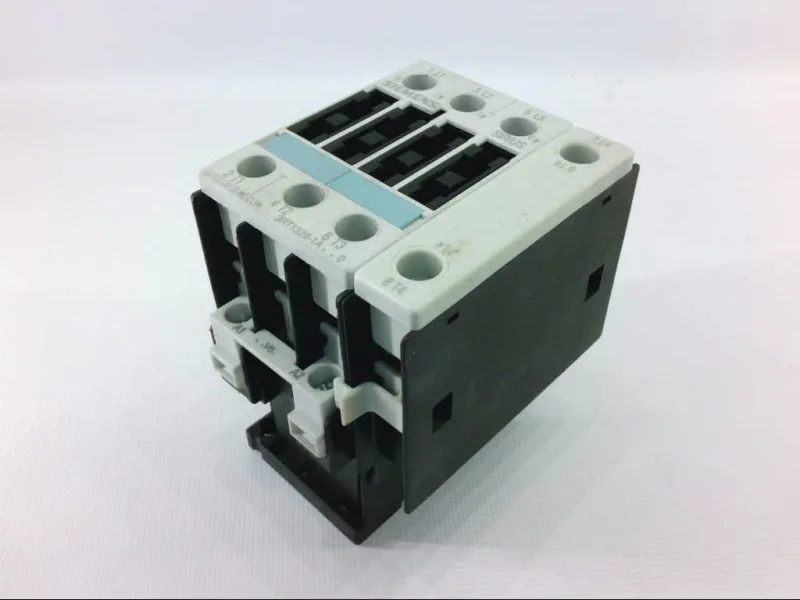
The Siemens SIRIUS 3RT1326-1AV60 is a 4-pole power contactor in the size S0 frame, rated for motor switching at 11 kW under AC-2 duty at 400 V. It carries four normally-open main contacts, so it handles three-phase motor loads plus a fourth pole for a neutral or auxiliary switching path — common in star-delta or two-speed motor circuits where the fourth pole breaks the control supply or a heater element.
The headline motor rating is 11 kW at AC-2 at 400 V. AC-2 covers slip-ring motor starting and reversing — the contactor sees moderate inrush but makes and breaks under load. For a standard squirrel-cage motor (AC-3 duty), the same contactor typically derates; the evidence does not list an AC-3 value, so size the contactor against the motor's full-load current, not the AC-2 kW figure. The main circuit terminals accept solid conductors from 2x (0.5... 1.5 mm²) up to max. 2x (0.75... 4 mm²), and finely stranded with core-end processing the same range. For AWG, the terminals take 2x (20... 16) up to 1x 12. This covers most panel wiring up to 4 mm² (roughly 12 AWG), which matches the 35 A fuse required for Type 2 coordination. Auxiliary contact ratings are given across several voltages: 10 A at 24 V, 6 A at 230 V, and 3 A at 400 V. These are the switching capacities for the control circuit — useful when the contactor's own auxiliary block drives a PLC input or a pilot light. The contactor is rated for side-by-side mounting without derating, which saves panel width. Depth is 91 mm, width 61 mm, height 85 mm — the S0 footprint is a common size across the SIRIUS family, so panel cutouts and busbar systems designed for S0 will accept this unit directly.
As a SIRIUS S0 contactor, it shares its mounting footprint and terminal layout with other S0-family contactors and overload relays. If a panel was originally specified around a different S0 contactor (like the 3RT1023-1AL20), the 3RT1326-1AV60 will drop onto the same DIN rail and accept the same busbar system, but the auxiliary contact configuration and coil voltage must be checked separately — the evidence does not list the coil voltage for this unit.
Where it goes in a panel
This contactor is a standard building block for motor control centers, conveyor drives, pump panels, and compressor starters. The 4-pole configuration suits applications where a fourth pole switches a heater, a control transformer primary, or a neutral disconnect. The screw terminals are field-wireable without special tools, and the snap-on DIN rail mount speeds panel assembly. Above that, the dielectric strength and thermal dissipation decrease — standard practice is to derate current by about 1% per 100 m above 2 000 m. This suits most industrial environments but not clean-room or medical-grade air.