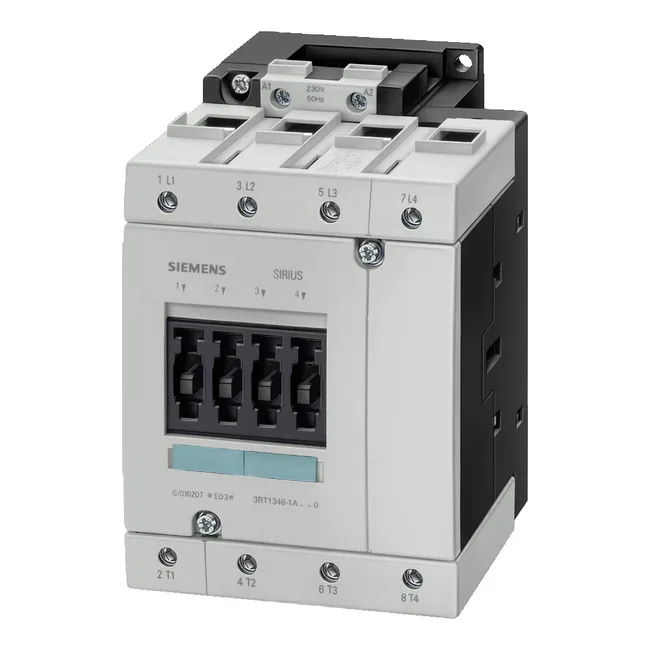
It carries a rated insulation voltage of 1000 V and is rated for 42 kW at 230 V at 60 °C, making it a fit for moderate-to-large motor applications on 230 V three-phase systems. The contactor mounts on standard 35 mm or 75 mm DIN rail using screw and snap-on fastening, and its front face carries an IP20 protection rating with the cover or box terminal installed — enough for basic touch protection inside a panel.
The 42 kW motor power rating at 230 V at 60 °C is the headline figure for sizing — it tells you the largest standard three-phase induction motor this contactor can switch under continuous duty at that temperature. For DC switching, the contactor is rated 10 A at 24 V, 2 A at 60 V, 1 A at 110 V, and 0.3 A at 220 V. These are the maximum DC-1 or DC-13 resistive/inductive loads at each voltage — useful if you are switching DC brake coils or small DC motors from the same contactor. The AC coil is rated for 400 V at 50 Hz and 400 to 440 V at 60 Hz, with an operating range of 0.8 to 1.1 times rated voltage at 50 Hz and 0.85 to 1.1 at 60 Hz. That is a high-cycle contactor — suitable for frequent start/stop applications like conveyor or pump cycling, not just infrequent isolation.
Terminal specs and wiring
Main circuit terminals are screw-type, accepting solid conductors from 0.5 to 4 mm² (two per terminal) and stranded conductors from 10 to 50 mm² (two per terminal). The larger stranded range (up to 50 mm²) covers the main power wiring for the 42 kW load; the smaller solid range is for control wiring on the same terminal block. The minimum cross-section at 40 °C and 60 °C is 35 mm² for the main circuit — that is the smallest wire that meets the thermal rating at those ambient temperatures.