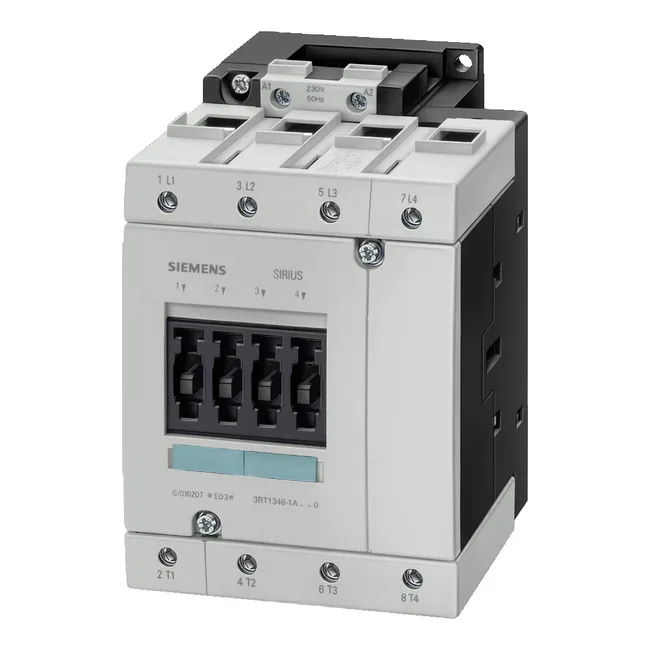
The Siemens 3RT1344-1AV00 is a SIRIUS S3 power contactor rated for motor switching at 42 kW at 230 V at 60 °C, with a rated operational voltage of 400 V at 50 Hz. The coil operating range spans 0.8 to 1.1 times the rated voltage at 50 Hz, which means the coil holds in reliably down to 320 V on a 400 V nominal system — a margin that matters when the bus sags under a large motor start. Its insulation voltage is rated at 1 000 V and surge voltage resistance at 6 kV.
The contactor measures 146 mm high by 93 mm wide by 139 mm deep. That 139 mm depth is the dimension to check against your enclosure back-panel clearance, especially if you are retrofitting into an existing cabinet where the gland plate or door-mounted devices limit reach. Front protection is IP20 with the cover or box terminal installed; the terminal itself is IP00. In a panel with IP54 or better overall rating, the IP20 front is adequate for finger-safe touch protection during commissioning.
Solid wire capacity covers 2x (0.5... 1.5 mm²), 2x (0.75... 2.5 mm²), and up to 2x (0.75... 4 mm²). Stranded conductors accept 2x (10... 50 mm²). Auxiliary and control circuits also terminate on screw-type terminals, with solid or stranded capacity of 2x (2.5... 16 mm²). This keeps the same tooling across both power and control wiring.
Switching performance and coordination
For resistive loads at AC-1, the maximum switching frequency is 1 000 cycles per hour, which is adequate for most conveyor and pump cycling but not for high-speed indexing applications. The arcing time is the interval the contacts carry current after the coil drops out; for Type 2 coordination (no-weld requirement), the evidence specifies a fuse of 125 A gL/gG. That fuse rating is the one to coordinate with upstream protection if you are designing for selectivity. DC switching capacity is derated significantly from the AC ratings: 10 A at 24 V, 2 A at 60 V, 1 A at 110 V, 0.3 A at 220 V, and 6 A at 230 V (likely AC-3 or AC-4 duty at that voltage). The 400 V DC rating is 3 A. For any DC load above these levels, you would need a DC-rated contactor or a series arc-suppression network.