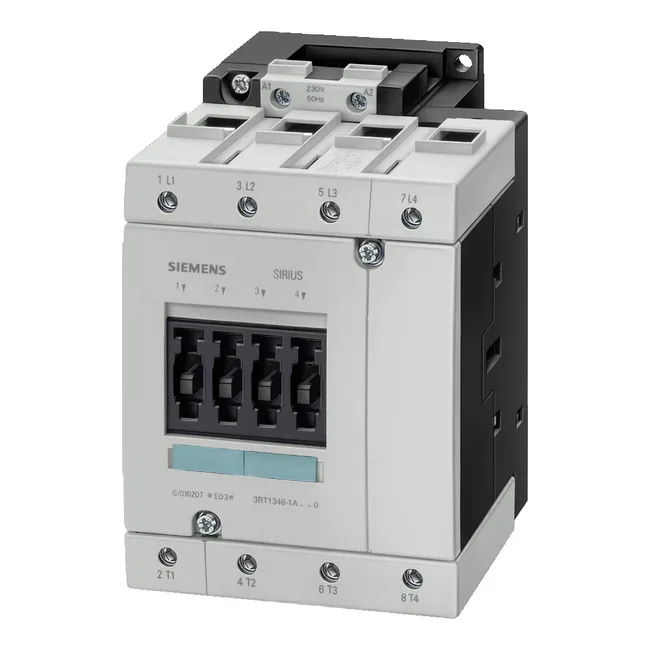
The Siemens 3RT1344-1BB40 is a SIRIUS power contactor in the S3 frame size, rated for switching motor loads up to 42 kW at 230 V AC-3 duty — that's the rating that governs real motor starts, not the thermal current. Insulation voltage is 1000 V, so it handles 400 V and 690 V line supplies without derating the creepage path. Mounts on 35 mm or 75 mm DIN rail via screw and snap-on fastening — no adapter plate needed. Side-by-side mounting is permitted, which keeps panel width tight when you're stacking multiple contactors on a motor control center bus.
The 42 kW at 230 V AC-3 figure is the motor-switching capacity — that's the one that decides whether this contactor handles your pump or conveyor motor. At 400 V AC-3, expect roughly 75 kW (the standard scaling for a 230 V base rating), though the exact number depends on the motor full-load current and the utilization category. The IP20 front protection with cover or box terminal keeps fingers out; the terminal area itself is IP00, so the panel enclosure provides the final ingress barrier. Coil is 24 V DC, drawing 15 W closing power. That's a standard PLC output voltage, but the 15 W inrush means your 24 V DC supply needs enough headroom — a 24 V, 2 A supply can handle about three of these coils closing simultaneously. The 60 °C upper operating limit is useful near furnace lines or in sealed cabinets with minimal ventilation.
Main current circuit uses screw-type terminals accepting 2x (10...50 mm²) stranded or 2x (10...1/0) AWG. The 35 mm² minimum permissible cross-section at 40 °C and 60 °C tells you the lug size needed for full rated current. Fuse protection for type 2 coordination requires gL/gG fuses rated 125 A. That's the upstream short-circuit protection that lets the contactor survive a fault without welding its contacts.
Substance prohibitance date of 05/01/2012 aligns with RoHS compliance. The contactor carries the usual Siemens CE and UL/CSA markings for IEC and North American installations — confirm the specific UL file number on the nameplate if your site requires it.