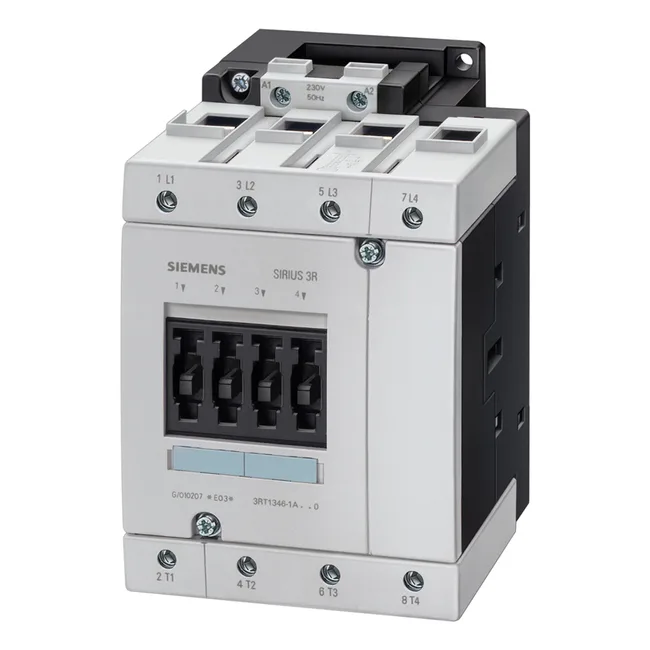
Its 53 kW rating at 230 V 60 °C tells you it can handle a 53 kW motor under those conditions — the real-world thermal limit at elevated ambient. The insulation voltage is rated 1 000 V, giving headroom for 400 V and 690 V systems.
The 53 kW at 230 V 60 °C is the motor-switching capacity under continuous duty at elevated ambient — if your panel runs cooler, you get headroom. The contactor also carries rated operational currents for resistive loads: at AC-1 maximum it can handle 1 000 switching cycles per hour. For DC switching, the 24 V rated value is 10 A, dropping to 0.3 A at 220 V — typical for a power contactor, not a DC relay. The mechanical life is typical 10 000 000 operations, which is standard for this class.
Main circuit terminals accept solid conductors: 2x (0.5... 1.5 mm²), 2x (0.75... 2.5 mm²), max. 2x (0.75... 4 mm²), and stranded: 2x (10... 50 mm²). At 40 °C the minimum permissible conductor is 50 mm²; at 60 °C it derates to 35 mm². AWG cables for main contacts are 2x (10... 1/0).