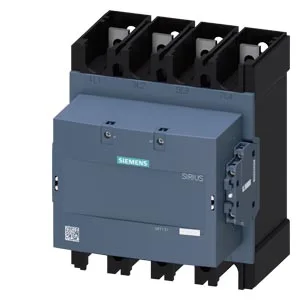
The S12 frame is a common footprint in European-style panels, and this one carries a 48-130 V AC coil — that's the voltage range the coil will pull in at, not the main contact rating. The coil draws 17 VA at both 50 and 60 Hz, so the control transformer sizing is straightforward across line frequencies. It's a screw-fixing mount, not a DIN-rail snap-on, so you'll be bolting it to a backplate or mounting rail. The mounting position is flexible: vertical surface, can be rotated ±180°, and with 0° rotation can be tilted forward or backward ±30°, or standing. That gives you some layout freedom in a crowded cabinet.
The coil pickup voltage is 0.8 x rated value, and dropout is 1.1 x rated value — so on a 110 V AC control circuit, the coil will pick up at about 88 V and drop out around 121 V. That's a standard margin for AC contactors, but worth checking if your control voltage sags under load. The auxiliary contact block is built in — 2 instantaneous contacts, rated at 24 V (3 A), 48 V (1.5 A), 110/125 V (0.55 A), 220 V (0.3 A), 230 V (4 A), 400 V (3 A), 500 V (2 A), and 690 V (2 A). Those are the switching capacities for the aux contacts, not the main poles. The 4 A at 230 V is the highest figure, so if you're switching a 230 V pilot light or PLC input, that's your limit per contact. Not a fast-switching device, but typical for a contactor this size.
Physical fit and clearances
Dimensions: 225 mm high, 184 mm wide, 180 mm deep. That depth is the body depth, not including any protruding terminals or arc chutes — check your enclosure depth against that figure. That's for heat dissipation and arc flash clearance, not just air flow. The contactor can handle up to 2 attachable auxiliary blocks if you need more than the built-in 2 contacts.
No need to hunt surplus or broker channels. The SIRIUS series is widely stocked, and the S12 frame is a common size, so lead times are typically manageable through distribution.