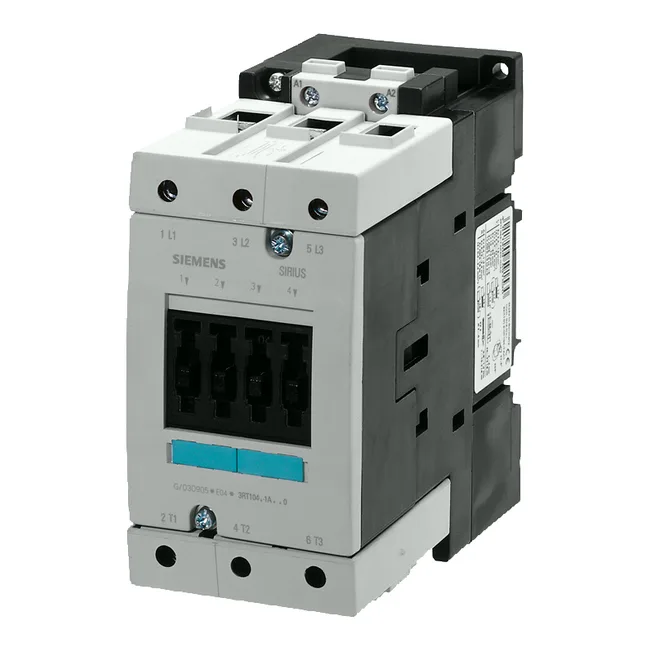
It carries a rated power of 38.2 kW at 690 V AC-3, making it suitable for larger three-phase induction motors in that voltage class. At 500 V AC-3, the rating is 29.9 kW, and for AC-2 duty at 400 V it is rated at 22 kW — the AC-2 figure matters for slip-ring motor starting or other applications where the contacts close under load but open with reduced current. The coil is wound for 100 V at 50 Hz and 100 to 110 V at 60 Hz, with an operating range of 0.8 to 1.1 times rated voltage at 50 Hz and 0.85 to 1.1 at 60 Hz. That means the coil reliably picks up between about 80 V and 110 V at 50 Hz, and between 85 V and 121 V at 60 Hz — a wide enough band to tolerate typical line sag without dropping out. Auxiliary contact ratings cover common control voltages: 10 A at 24 V, 6 A at 230 V, 3 A at 400 V, and 0.3 A at 220 V DC. The DC rating at 220 V is the limiting one for inductive DC loads — that 0.3 A figure governs the maximum solenoid or relay load the auxiliary contacts can break.
The S3 frame occupies 70 mm width, 146 mm height, and 139 mm depth — that depth is the dimension from the rail to the furthest point of the contactor, so check enclosure depth clearance before panel layout. Side-by-side mounting is permitted, which means no mandatory spacing between units when installed in a row on the same rail. Main circuit terminals are screw-type, accepting stranded conductors up to 2x 50 mm² and solid conductors from 0.5 mm² up to 4 mm². At 40 °C ambient, the minimum permissible cross-section is 50 mm²; at 60 °C it derates to 35 mm² — that derating reflects the higher resistance and heat buildup in smaller conductors at elevated enclosure temperatures. The terminal itself is rated IP00, while the front of the contactor with cover or box terminal achieves IP20, sufficient for finger-safe touch protection inside a locked panel.
The maximum switching rate in AC-1 duty is 650 cycles per hour, which sets the thermal limit for repetitive resistive-load switching.