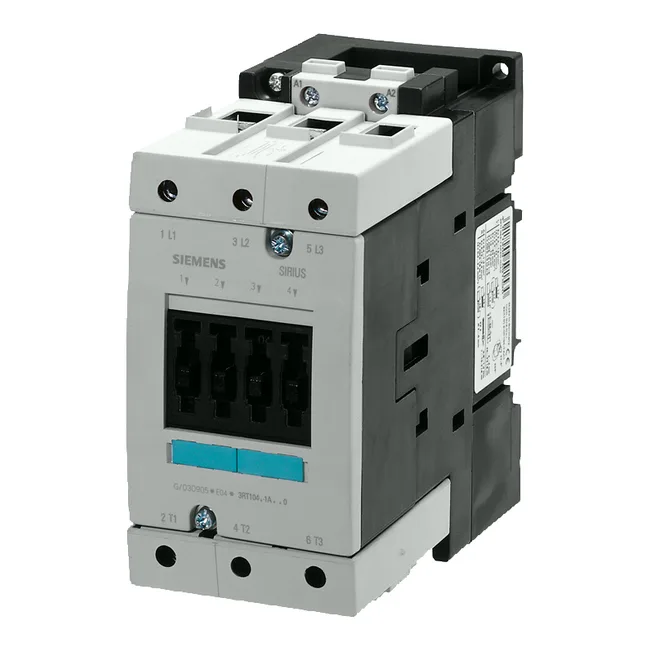
Rated insulation voltage is 1 000 V, and the contactor carries motor loads up to 50 kW at 230 V (at 60 °C) and 148 kW at 690 V (at 60 °C). For AC-2 duty at 400 V, it handles 22 kW — that's the rating for slip-ring motor starting, where the contactor closes and opens under load. The main current circuit uses screw-type terminals, accepting stranded conductors from 10 mm² up to 50 mm² (at 40 °C) or 35 mm² (at 60 °C). Solid wire connections are supported in the control circuit: 2x (0.5 to 1.5 mm²) or 2x (0.75 to 2.5 mm²), max 2x (0.75 to 4 mm²). That covers most panel-building wiring without adapters.
Switching capacity and duty
For DC switching, the contactor is rated 10 A at 24 V, 2 A at 60 V, 1 A at 110 V, and 0.3 A at 220 V. These are the make/break capacities for the auxiliary contacts — useful when the contactor also controls a pilot circuit or small solenoid. Mechanical life is typical 10 000 000 operations.
Mounting and enclosure protection
This is typical for industrial control panels not in a clean-room environment — the contactor expects the panel to keep condensation off the terminals.