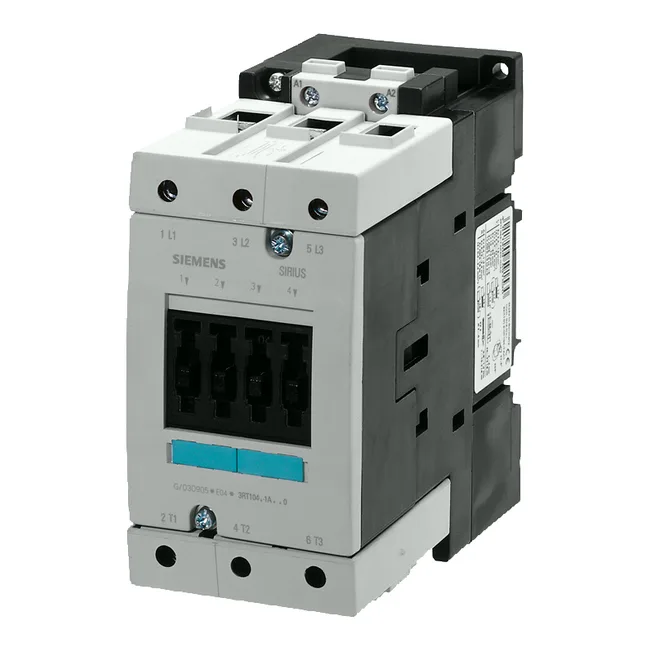
Its 1 000 V rated insulation voltage and pollution degree 3 rating suit it for environments with conductive contamination, typical of factory-floor enclosures. For resistive heating or lighting loads (AC-1), it delivers 50 kW at 230 V and 148 kW at 690 V at 60 °C, which is the rating that governs continuous current-carrying capacity in a warm cabinet.
The 90 mm width and 146 mm height with 139 mm depth define the panel footprint. Side-by-side mounting is permitted, so multiple contactors can be ganged without spacing gaps, saving DIN-rail length. Main circuit connections are screw-type terminals, accepting solid conductors from 2x 0.5 mm² up to 2x 4 mm², or AWG 7 to 1/0. For derating, the minimum permissible cable cross-section at 40 °C is 50 mm² and at 60 °C is 35 mm² — a reminder that the terminal lug must be sized for the actual load current, not just the wire gauge.
Switching Performance and Endurance
Maximum switching rate at AC-1 is 650 operations per hour. Arcing time spans 10 to 15 ms. Operating times: at AC, 10.6 g at 5 ms and 6.2 g at 10 ms; at DC, 14 to 20 ms. The operating factor at 60 Hz is 0.8 to 1.1, meaning the contactor can be energized continuously at rated voltage without overheating the coil. Auxiliary contact ratings cover 10 A at 24 V, 2 A at 60 V, 1 A at 110 V, 0.3 A at 220 V, 6 A at 230 V, and 3 A at 400 V — these are the make/break capacities for control circuits, not the main power path.