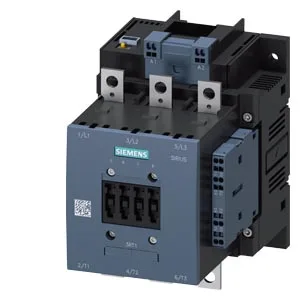
Its headline AC-1 rating of 96 A at 480 V defines the continuous resistive current it can carry — that's the figure to use for heater banks or lighting loads. For motor duty, the AC-3 rating (not listed here but typical for this frame) governs the breaking of locked-rotor current; the 96 A AC-1 value gives headroom for derating when switching inductive loads in a petrochemical environment where the contactor sits inside a safety instrumented function loop. The contactor occupies a 172 mm height by 120 mm width by 170 mm depth envelope, mounted via screw fixing to a vertical surface.
Termination and auxiliary contacts
The contactor accepts 2x (0.25 to 2.5 mm²) solid or stranded conductors per clamp — typical for control wiring up to 14 AWG. Arcing time falls between 10 and 15 ms, and the DC operating time is 80 to 90 ms. These timing figures matter when coordinating with upstream protective devices for selectivity — the arc clears fast enough to avoid nuisance fuse blowing on a motor branch circuit.
Environmental limits and clearances
Minimum air clearances are 10 mm upwards, 10 mm downwards, 10 mm at the side, and 20 mm forwards; respect these to avoid arc flash between phases in a 480 V panel.