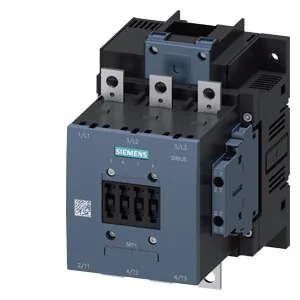
Size S6 frames the physical envelope: 172 mm tall, 120 mm wide, 170 mm deep, so it occupies a defined footprint on the DIN rail or screw-fixed backplate. The coil is screw-type terminals, and an auxiliary switch is built in, meaning you get one less add-on module to order and wire.
The main power circuit accepts stranded conductors from 25 mm² up to 120 mm² — that's the range for the load-side and line-side cables. For a motor feeder, 120 mm² copper roughly corresponds to a 250–300 A circuit, so this contactor is sized for a substantial motor or a group of smaller loads. The auxiliary contacts handle 10 A at 24 V, 2 A at 48 V, 2 A at 60 V, 1 A at 110 V, 0.9 A at 125 V, 0.3 A at 220 V, and 6 A at 230 V — these are the switching capacities for the control circuit, not the main power path. The coil operates on AC or DC, rated 42–48 V, with a pickup time of 40–60 ms and an arcing time of 10–15 ms. Mounting is vertical, rotatable ±90°, tiltable ±22.5° front/back — gives flexibility for tight cabinet layouts.
Fastening method is screw fixing — not a snap-on DIN rail mount. That means you need to drill and tap the backplate or use a mounting rail adapter. The single mounting hole is 9 mm diameter. The auxiliary switch is already attached, so you don't need to order a separate module, but verify the contact configuration matches your control scheme. The coil terminals are screw-type, so expect to use a screwdriver for termination — no spring-cage here.