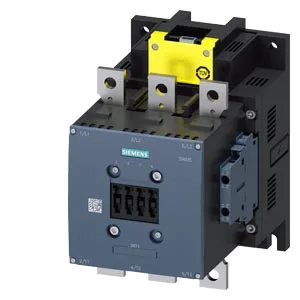
SIRIUS S10 contactor for high-cycle motor switching
The Siemens 3RT1466-6SP36 is a size S10 SIRIUS contactor rated for 200-277 V AC/DC coil supply, with screw-type terminals on both coil and main power circuit. The 10 000 000 mechanical cycles and 75 a MTBF place this squarely in continuous-duty applications where contactor life drives the maintenance interval — think conveyor lines, pump stations, or compressor skids running multiple shifts. The arcing time of 10-15 ms is typical for this frame class and informs the minimum off-time for reversing or inching applications. Power terminals accept stranded conductors from 70 up to 240 mm², while the auxiliary and coil terminals handle 0.5-4 mm² solid or stranded. This wire range covers most panel-to-motor junction boxes without needing adapter lugs.
Mounting and integration flexibility
Mounting is by screw fixing through a single 11 mm hole, with the contactor body measuring 210 mm high, 145 mm wide, and 202 mm deep. These are the minimum air gaps for heat dissipation and arc quenching — stacking contactors closer than this derates the thermal capacity. The contactor accepts up to four attachable auxiliary switch blocks, and the auxiliary contacts are rated for 10 A at 24 V, 2 A at 48/60 V, 1 A at 110 V, 0.9 A at 125 V, and 0.3 A at 220 V — covering typical PLC-level signal loads.