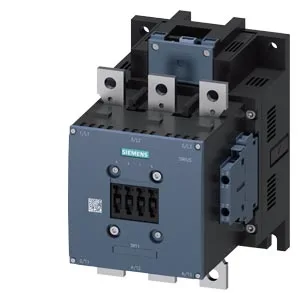
It is fitted with a 96-127 V AC/DC coil, meaning the same coil accepts either AC or DC control voltage within that range — useful when a panel has mixed control supplies or you are standardizing on a single coil variant across AC and DC circuits. The coil termination uses screw-type terminals, so expect to land the control wires with a screwdriver rather than spring-cage or ring-tongue.
The main power circuit accepts stranded cable from 70 mm² up to 240 mm² — sized for heavy motor feeders or distribution loads. Auxiliary contact ratings are given per voltage: 10 A at 24 V, 6 A at 230 V, and 0.3 A at 220 V — these are the make/break capacities for the built-in aux contacts, not the main pole rating. If you are switching a 24 VDC PLC input, the 10 A rating gives ample margin; at 230 VAC the 6 A rating still covers most pilot-duty loads. The storage range is wider — that covers shipping and warehouse conditions, not running duty.
Mounting is by screw fixing through a single 11 mm hole — this is a bolt-down contactor, not a DIN-rail snap-on. Physical envelope: 210 mm high, 145 mm wide, 202 mm deep. The depth dimension matters for enclosure depth clearance — 202 mm means it will not fit a shallow 200 mm deep cabinet without a door offset. These are minimums for heat dissipation and arc containment — do not crowd the contactor against other components. Arcing time is 10-15 ms, and operating times (both AC and DC) are 80-100 ms. The arcing time is short enough that arc flash coordination with upstream breakers is straightforward.