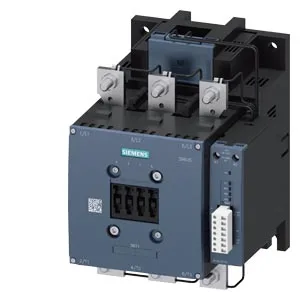
Siemens 3RT1467-6PP35 SIRIUS Contactor, S10 Frame
It lands in the middle of the SIRIUS lineup — bigger than the S6 or S0 frames, smaller than the S12, and sized for applications that need the 70-240 mm² stranded cable range and the 200-277 V AC/DC coil. The coil accepts both AC and DC at 200-277 V, with a pickup dropout ratio that holds in at 80% of rated voltage and drops out at 0.8 times the initial value. That wide tolerance means it stays latched through a saggy line or a weak generator start — useful on a motor control center fed from a transformer that's already loaded. Mounting is screw-fixed to a vertical surface, rotatable ±90° and tiltable ±22.5° front-to-back. That's not a DIN-rail clip — plan for panel drilling. The contactor sits 210 mm tall, 165 mm wide, 202 mm deep, so leave room in the enclosure for the arc chutes and the cable bend radius on the 240 mm² tails.
The 70-240 mm² stranded termination is the headline here — that's a heavy cable range, typical for a 300+ A motor circuit or a feeder tap. The screw-type coil terminals accept 2x 0.5-1.5 mm² solid or 2x 0.75-2.5 mm² stranded, max 2x 0.75-4 mm². That's enough for a 1.5 mm² control wire from a PLC output or a relay, but if you're paralleling two 4 mm² feeds for the coil, you're at the limit. Arcing time runs 10-15 ms, and the dropout delay is 80-100 ms on both AC and DC. That's fast enough for basic motor protection coordination, but if you're sequencing contactors for a reversing starter or a wye-delta transition, you'll want to check the overlap against your PLC scan cycle.
If your panel was built around a 3RT1264-6AP36-0KA1 or a 3RT1076-6AP36, those are different frame sizes and coil voltages — the S10 is physically larger and the coil range is different, so don't assume a drop-in swap without checking the mounting hole pattern and the cable lug clearance.