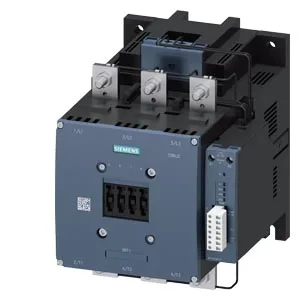
The S12 frame is the largest in the SIRIUS contactor family, sized for high-current applications where the main power circuit needs 70 to 240 mm² stranded cable on the lugs. It measures 214 mm high by 180 mm wide by 225 mm deep, which means it needs a full-depth enclosure or a deep backpanel — not a shallow 200 mm box. The coil is rated for 200 to 277 V AC/DC.
This contactor includes an auxiliary switch block, and the breaking capacity varies significantly with voltage — something that catches people out when they reuse the same contactor across different control voltages. At 24 V it switches 10 A, but at 220 V that drops to 0.3 A. The 230 V rating jumps back to 6 A, which suggests that rating is for a different load type (likely AC resistive vs DC inductive). If you're switching a 220 VDC solenoid with this auxiliary, the 0.3 A limit is real — don't assume the 24 V rating scales.
Wiring and integration notes
Main power lugs accept 70 to 240 mm² stranded cable — that's heavy cable, typically 4/0 AWG to 500 kcmil equivalent. The auxiliary/coil terminals are screw-type, accepting solid or stranded from 0.5 to 4 mm² (roughly 20 to 12 AWG). Keep the control wiring separate from the power lugs to avoid noise coupling; the contactor itself is a noise source during switching. Plan your enclosure depth to account for the 225 mm body plus the 20 mm forward clearance.