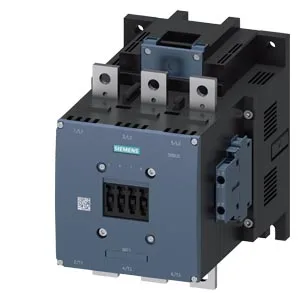
It carries a 200-277 V AC/DC coil, so it can be driven from a common control transformer or a DC power supply without needing a separate coil variant. The contactor mounts via screw fixing (four M11 holes on a 180×214 mm footprint) and accepts stranded cable from 70 to 240 mm² on the main power terminals. That range covers most motor feeds up to roughly 200 A depending on duty cycle and ambient temperature.
Coil and auxiliary ratings
The coil operates on AC or DC from 200 to 277 V. An auxiliary switch block is built in (screw-type terminals), rated for switching at various control voltages: 10 A at 24 V, 2 A at 48 V and 60 V, 1 A at 110 V, 0.9 A at 125 V, 0.3 A at 220 V, and 6 A at 230 V. These are the maximum resistive break currents — inductive loads like relay coils will need derating. Arcing time is 10-15 ms, which is typical for a contactor of this size and helps with coordination in a fused or breaker-protected circuit.
That covers most panel layouts without needing a special bracket. The 10 mm side gap is tight — verify adjacent components don't exceed that before wiring. The storage limit is mainly for shipping and idle spares, not running duty.