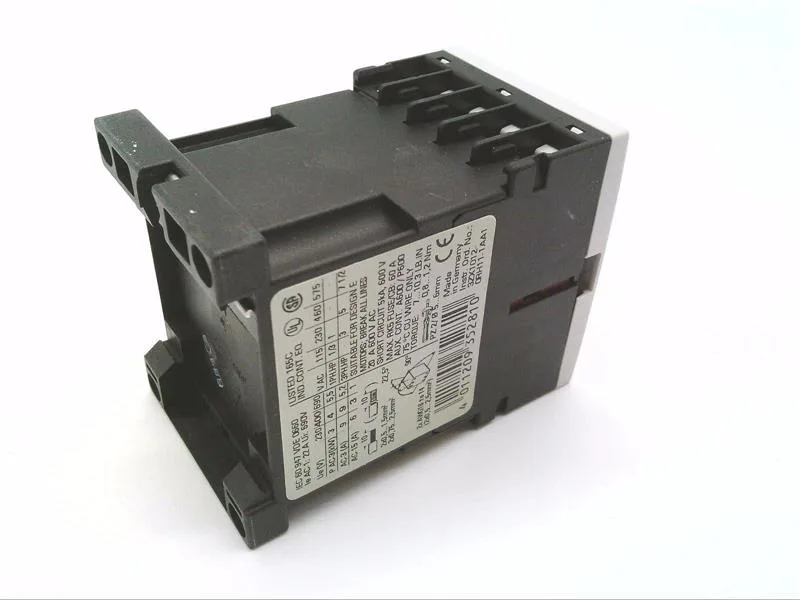
The screw-type terminals on both main and auxiliary circuits accept the wire sizes listed — 2x (0.5 to 1.5 mm²) solid, 2x (0.75 to 2.5 mm²), up to 2x (0.75 to 4 mm²) — so it's a direct fit for standard panel wiring practices.
The main circuit is rated for an impulse withstand voltage of 6 kV, which covers standard 400 VAC industrial environments with adequate clearance. The auxiliary circuit shares the same 6 kV rating, so signal isolation is consistent across the board. For short-circuit protection, the required fuse is gL/gG 20 A — that's the maximum to keep the contactor's let-through within its breaking capacity. The contactor's mechanical life is typical at 30 million operations, which means it'll outlast most machines in light-duty cycling. The switching times are 4 to 30 ms for AC and 25 to 100 ms for DC — the DC coil is slower to drop out, so factor that into your safety circuit timing if you're using it for emergency stop. Arcing time runs 10 to 15 ms, which is standard for this frame size. The 24 VDC coil draws 5.1 VA at 50 Hz and has a power factor of 0.27 at 60 Hz — that's the inrush for sizing your control transformer.
Contact Ratings — The Numbers That Matter for Your Load
The main contacts are rated at 10 A at 24 V, 6 A at 230 V, and 3 A at 400 V. That's the AC-1 resistive load curve — for motor loads (AC-3), you'd typically derate further, but these numbers give you the thermal current capacity. The auxiliary contacts — one NO and one NC — each carry 9 A continuously, with the NC contact rated at 16 A at 24 V for higher inrush on pilot duty. For DC switching, the ratings drop with voltage: 2 A at 60 V, 1 A at 110 V, 0.8 A at 440 V, and 0.3 A at 220 V. That's typical for a contactor this size — DC arcs are harder to extinguish, so don't assume the AC rating carries over. If you're switching a DC solenoid or brake, use the DC column.
For compliance, the part carries a substance prohibitance date of July 1, 2006, which aligns with RoHS and REACH requirements. The SIRIUS series is widely stocked, so lead times are typically standard for the class — no special-order headache here.