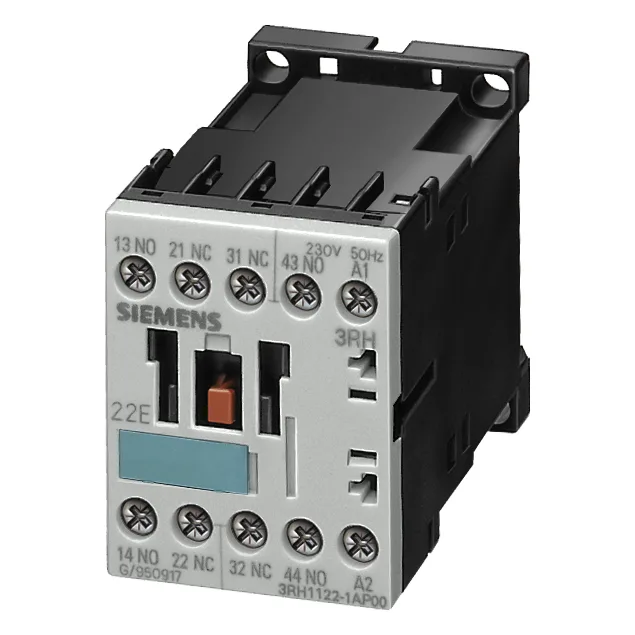
Rated for 10 A at 24 V DC and 6 A at 230 V AC, it also handles 3 A at 400 V AC — covering common control and light motor loads in industrial environments. The main circuit and auxiliary contacts are rated for 9 A each, with an impulse withstand voltage of 6 kV for the main circuit. Protection is IP20 on the front and at the terminals, which is standard for enclosed panel mounting — no washdown rating here, so keep it behind a sealed cabinet door in wet areas.
For higher DC voltages, the current drops sharply: 2 A at 60 V, 0.3 A at 220 V, 0.8 A at 440 V. If your circuit runs at 110 V DC, you're limited to 1 A. Always check the DC curve before committing the BOM line. The AC-1 maximum switching frequency of 1,000 operations per hour means it's fine for cyclic loads, not continuous high-speed pick-and-place. Terminals are spring-loaded, accepting 2x (0.25 to 2.5 mm²) solid or stranded wire — no screw torque to check, but you need the right ferrule size for stranded. The 2.5 mm² maximum at AC-1 rated current is the practical limit for power wiring.
If you're looking at a 3RT1016-2AP02 as a potential cross-reference, note that the 3RT1516-2BM40 is a size S00 contactor with spring-loaded terminals and a 10 A DC rating. The 3RT1016-2AP02 is a different variant in the same SIRIUS family; verify terminal style and DC rating before substituting — the footprint on DIN rail is the same, but the wiring and coil specs may differ.
Integration notes
The altitude limit is 2,000 m — above that, derate for air density. The coil pick-up voltage is 0.85 of rated (initial value), and the drop-out delay at DC is 7 to 10 ms, with arcing time of 10 to 15 ms.