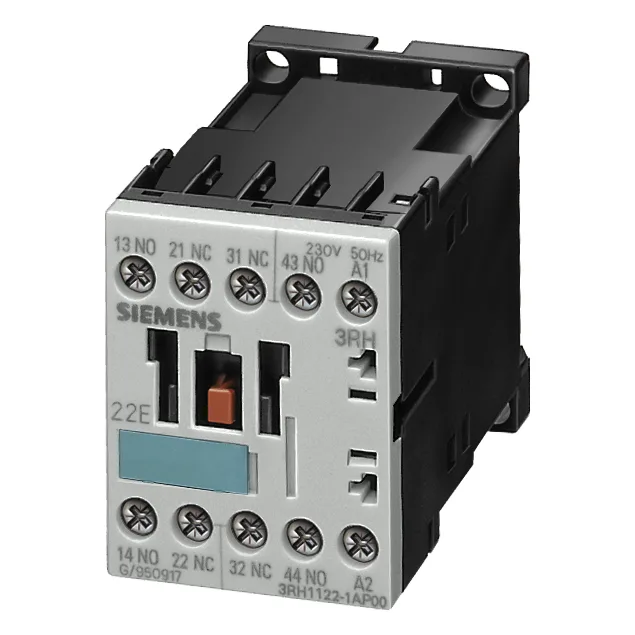
The 24 VDC coil draws 4.4 VA at 50 Hz and operates across a 0.85–1.1x rated voltage range typical for SIRIUS contactors. The 10 A rating at 24 VDC is the continuous current the main contacts handle; for DC switching at higher voltages the rating drops — 2 A at 60 VDC, 1 A at 110 VDC, 0.3 A at 220 VDC — so if your circuit is 48 VDC or 125 VDC, interpolate between those points. AC switching at 230 VAC is 6 A, at 400 VAC it's 3 A. The auxiliary contact block is built in: one normally open and one normally closed contact, each rated 12 A. That's enough for a standard feedback loop to a PLC input or a holding circuit. Arcing time runs 10–15 ms, and the minimum switching load at AC is 4–30 ms — fine for most pilot-duty circuits, but if you're switching a very low-current signal (milliamps), verify the minimum load spec separately.
Width is 45 mm, depth 72 mm, height 57.5 mm — fits a standard S00 footprint. Side-by-side mounting is allowed; minimum spacing to adjacent components on the side is 6 mm. Mounting position: vertical surface, rotatable ±180°, tiltable ±30° front/back. No forced derating for side-by-side in still air at 60 °C ambient, but if you're stacking in a sealed enclosure, account for the heat from the 4.4 VA coil. Screw terminals accept 2x (0.5–1.5 mm²) solid or 2x (0.75–2.5 mm²) stranded, max 2x (0.75–4 mm²). That's typical for a Size S00 contactor — fine for control wiring up to 4 mm². For the main circuit, the max wire size at AC-1 rating is 2.5 mm², so don't plan on landing 6 mm² motor leads directly; use a terminal block or a larger contactor frame.