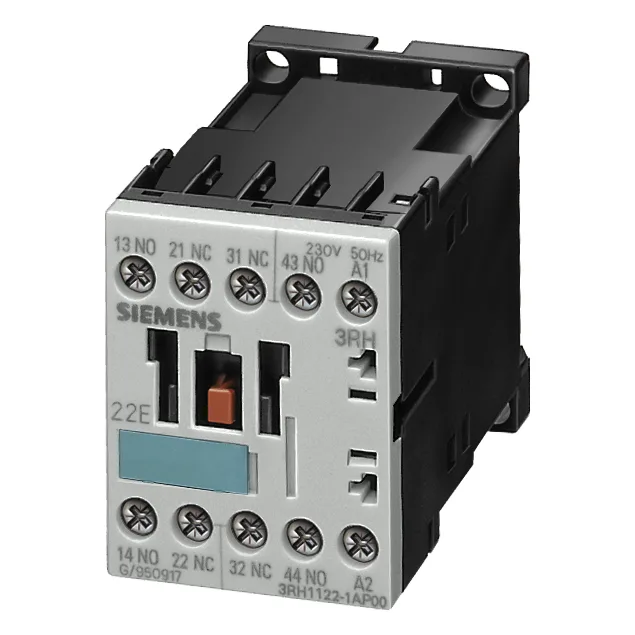
It mounts via screw or snap-on onto 35 mm DIN rail per EN 50022, fitting into the compact S00 footprint at 45 mm wide, 60 mm tall, and 72 mm deep — a space-saving choice for high-density panel layouts. The main circuit uses spring-loaded terminals accepting 2x (0.25 … 2.5 mm²) solid or stranded wire, reducing wiring time and ensuring vibration-resistant connections. Rated for operation from -25 °C to +60 °C and storage from -55 °C to +80 °C, with IP20 finger-safe protection on the front and terminals. The contactor can be mounted on a vertical surface with ±180° rotation and ±30° tilt, offering flexibility in cabinet layout.
DC switching capability — what the ratings mean
This contactor carries DC switching ratings across multiple voltage levels, which is the critical selection parameter for DC load circuits. At 24 V it switches 10 A; at 60 V it switches 2 A; at 110 V it switches 1 A; at 220 V it switches 0.3 A; at 230 V it switches 6 A; at 400 V it switches 3 A; and at 440 V it switches 0.8 A. These are not continuous current ratings — they reflect the contactor's ability to break a DC arc at those voltages, which is inherently more difficult than AC. For a 24 VDC control circuit or small DC motor brake, the 10 A rating gives comfortable headroom; at higher DC voltages the current must be derated significantly. AC-1 maximum switching frequency is 1,000 operations per hour.
Panel integration — DIN rail and clearance
Side-by-side mounting is permitted (no derating required for adjacent units), with a minimum 6 mm clearance to the side for wiring access. The IP20 front and terminal protection means it is finger-safe for installation in enclosed panels — no additional shrouding needed for operator safety. The S00 frame size (45 mm wide) allows high-density packing on the rail. For panels with limited depth, the 72 mm depth fits standard 80 mm deep enclosures with clearance for wiring behind the rail.