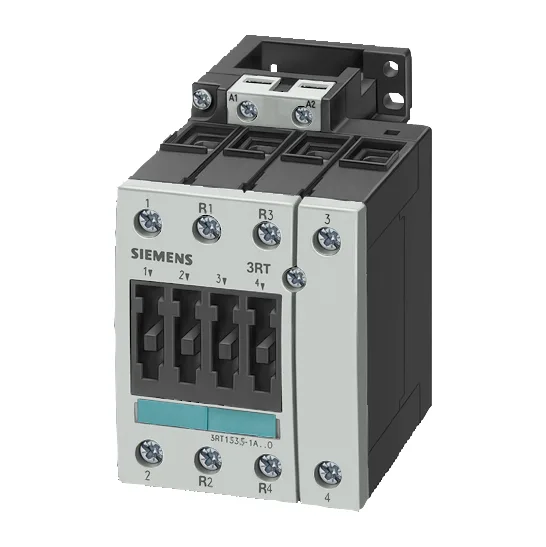
The coil is rated 48 V DC, with screw-type terminals. Switching capacity varies by voltage: at 24 V DC it handles 10 A, at 60 V DC it drops to 2 A, at 110 V DC it's 1 A, at 220 V DC it's 0.3 A. For AC loads: 230 V AC at 6 A, 400 V AC at 3 A, 440 V AC at 1 A. These are the numbers that decide whether this contactor can handle your specific load — don't just look at the max rating, match the voltage column. Auxiliary contacts are rated 40 A per NC and per NO contact — that's the same rating for both, so you don't have to derate the NC side. If your panel sits in a non-conditioned space that sees summer heat, the +60 °C operating limit is the one to watch — derate switching capacity above 40 °C per the thermal curve.
Main circuit terminals are screw-type, accepting solid wire: 2x (0.5 to 1.5 mm²), 2x (0.75 to 2.5 mm²), max 2x (0.75 to 4 mm²). AWG for main contacts is 2x (18 to 2). Auxiliary and control circuits also use screw terminals — consistent termination throughout, no mix of spring and screw. Side-by-side mounting is allowed, with a 6 mm gap at the side for airflow. That's tight enough for dense panels but leaves room for heat dissipation from the coil.
RoHS compliance date is May 1, 2012, meaning it meets the EU RoHS directive for substances of concern. No UL or CSA marks are listed in the available data, but the SIRIUS series typically carries IEC certifications for global use — verify with your local Siemens representative for specific market approvals.