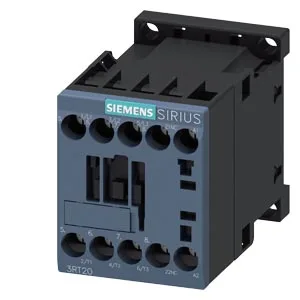
The contactor is rated for switching frequencies that depend on the duty class: up to 1,000 operations per hour in AC-1 (resistive) duty, 750 per hour in AC-2 and AC-3 (motor starting/running), and 250 per hour in AC-4 (plugging/inching). For a conveyor or pump running steady-state AC-3 duty, the 750 cycles/hour limit is the one that governs — it allows a cycle every 4.8 seconds, which covers most process rates without oversizing. The auxiliary contact ratings vary by voltage: 10 A at 24 V, 2 A at 48 V and 60 V, 1 A at 110 V, 0.9 A at 125 V, 0.3 A at 220 V, 3 A at 400 V, and 0.14 A at 440 V. For a 24 VDC PLC input, the 10 A rating is generous — the real limit is the PLC's own input current, not the contact. At 400 V, the 3 A rating is the one to check if you are switching a small control transformer or indicator lamp. That covers most indoor panel environments; if the panel is near a furnace or in a desert enclosure, the +60 °C upper limit is the hard stop.
The contactor accepts solid or stranded wire from 0.5 to 4 mm², with dual-wire terminations possible: 2x (0.5 to 1.5 mm²), 2x (0.75 to 2.5 mm²), or 2x 4 mm². The coil terminals are screw-type, so a standard Pozidriv bit handles the connection. Clearance distances are 10 mm upwards, downwards, and forwards, 6 mm at the sides. That 6 mm side gap is the tightest constraint — adjacent devices need that breathing room for heat dissipation and wiring access. Main contact torque is specified at 20 to 12 (likely Nm, though the unit is truncated in the spec).