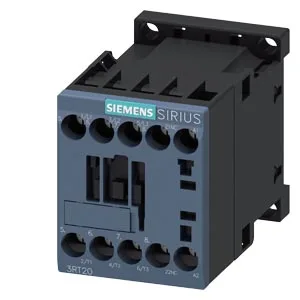
The 3RT2015-1AP02-ZX95: It mounts via screw or snap-on onto a 35 mm DIN rail per DIN EN 60715, and the mounting position allows +/-180° rotation on a vertical surface plus +/-22.5° tilt forward/backward — useful when you're squeezing it into a crowded panel and need to orient the coil terminals toward the wiring duct.
For a machine cycling once every 10 seconds, that's roughly 8.5 years of continuous 24/7 operation before the mechanism wears out. Switching frequency depends on the duty category: 1,000 cycles/hour at AC-1 (resistive loads), 750 cycles/hour at AC-2 and AC-3 (motor starting/running), 750 at AC-3e, and 250 at AC-4 (plugging/inching). If you're running a conveyor that starts and stops every 4 seconds, you're at 900 cycles/hour — that exceeds the AC-3 limit, so you'd need to derate or step up to a larger frame. When you lay out the DIN rail, you need that 6 mm side gap to adjacent devices for proper arc extinction and heat dissipation. Wire range accepts solid or stranded from 0.5 to 4 mm², with dual-wire capability: 2x (0.5 to 1.5 mm²), 2x (0.75 to 2.5 mm²), or 2x 4 mm². That's enough for most control-circuit wiring with standard ferrules. Auxiliary contact ratings at 24 V: 10 A; at 48 V: 2 A; at 60 V: 2 A; at 110 V: 1 A; at 125 V: 0.9 A; at 220 V: 0.3 A; at 400 V: 3 A; at 440 V: 0.14 A. Your 24 VDC power supply needs to handle the inrush peak, but the steady-state draw is under 300 mA. Operating times: AC operate 7 to 13 ms, arcing time 10 to 15 ms. That's fast enough for most motor-starting applications but not for high-speed synchronous switching where you need sub-millisecond precision.
Dimensions: 45 mm wide, 73 mm deep, 58 mm high. That's the standard S00 footprint, so it drops into any panel laid out for a SIRIUS S00 contactor without re-drilling the DIN rail or re-routing the wireway.