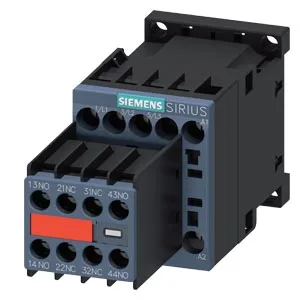
At 45 mm wide and 117 mm deep, it fits tightly in crowded enclosures where every millimeter of DIN rail counts.
This contactor is rated for AC-3 duty at 750 switching cycles per hour maximum — that's the standard motor-switching category for squirrel-cage motors: making and breaking running loads. For AC-1 resistive loads (heaters, lighting) it can handle up to 1,000 cycles/h, and for the heavier AC-4 category (plugging, inching, reversing) it's rated at 250 cycles/h. The AC-3e rating also sits at 750 cycles/h, matching the standard AC-3 figure for energy-efficient motor applications. For paralleled conductors, it accepts 2x (0.5...1.5 mm²), 2x (0.75...2.5 mm²), or 2x 4 mm² — useful when looping through auxiliary contacts or daisy-chaining control voltage across multiple devices. The arcing time sits between 10 and 15 ms at AC, which is typical for this frame size and helps with coordination when sizing upstream protection.
Clearance and wiring notes
These matter when packing multiple contactors side-by-side or against enclosure walls — the side clearance of 6 mm is tighter than the vertical clearances, so plan the DIN rail layout accordingly. Electrical life depends on the switching category and actual current; the switching frequency limits above (750/h for AC-3) govern the thermal duty cycle.