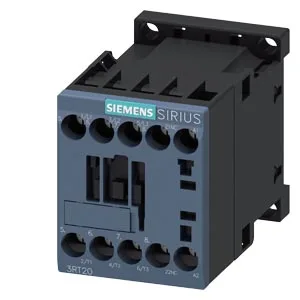
The auxiliary switch contacts are rated for a range of voltages: 10 A at 24 V, 2 A at 48 V and 60 V, 1 A at 110 V, 0.9 A at 125 V, 0.3 A at 220 V, 3 A at 400 V, and 0.14 A at 440 V. These ratings cover typical control-circuit loads across low-voltage and higher-voltage panels. Switching frequency depends on the duty class: up to 1,000 operations per hour at AC-1 (resistive), 750/h at AC-2 and AC-3 (motor start/run), and 250/h at AC-4 (plugging/inching). For AC-3e (energy-efficient motor starting) it also supports 750/h. That means for most conveyor or pump applications you can cycle it every 4–5 seconds without exceeding the mechanical limit.
That covers odd panel orientations where the rail isn't perfectly vertical. The terminal accepts solid or stranded wire: 2x (0.5…1.5 mm²), 2x (0.75…2.5 mm²), or 2x 4 mm² — no special ferrules needed for the smaller sizes. Clearance requirements: 10 mm upward and forward, 10 mm downward, 6 mm to the side.