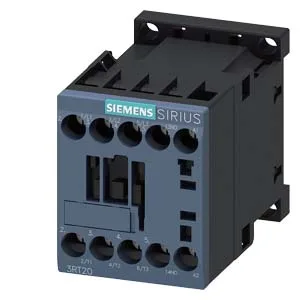
These are the minimum air gaps to maintain rated performance and avoid thermal coupling to adjacent components.
For motor loads, the AC-3 switching frequency is 750 operations per hour, which covers most conveyor, pump, and fan cycling without exceeding the contactor's thermal limit. Duty-class switching frequencies are specified: AC-1 (resistive) at 1,000 1/h, AC-2 and AC-3 (motor start/run) at 750 1/h, and AC-4 (plugging/inching) at 250 1/h. If your application involves frequent reversing or inching, the AC-4 ceiling of 250 cycles per hour is the governing limit — not the higher AC-3 figure. The coil draws 0.24 A at 50 Hz and 0.25 A at 60 Hz at its rated 24 V. That's a low control-power draw, so it won't stress a 24 VDC power supply shared with PLC outputs or sensors.
Wiring and Terminal Details
For doubled-up conductors, the range is 2x (0.5 to 1.5 mm²), 2x (0.75 to 2.5 mm²), or 2x 4 mm². That covers standard control wiring up to 12 AWG and allows daisy-chaining through the same terminal without a separate junction point.
Environmental and Lifecycle Considerations
The mechanical life of the contactor is typically 30,000,000 operations — that's the expected service life before the mechanism wears out, not the electrical endurance under load. Electrical life depends on the switching duty and load current, but the mechanical figure gives you a ceiling for high-cycle applications like sorting lines or pick-and-place cells.