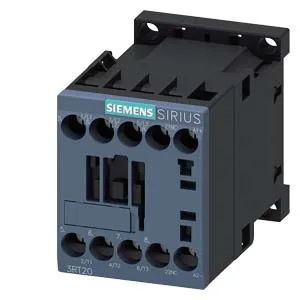
The coil holds at 24 V nominal and drops out when the voltage climbs above 1.1 times the rated value — that's your undervoltage protection built in. Out here in the grease, the 30 million mechanical-cycle rating means this contactor will outlast most of the gear it's switching. I've buried plenty of contactors that claimed high cycle life but couldn't take the heat and vibration of a real motor route. This one's rated for -25 to +60 °C operating and -55 to +80 °C storage, so it'll sit on a shelf or run in a warm cabinet without complaint.
The switching frequency tells you how hard you can push it. At AC-3 (motor starting), it's rated for 750 operations per hour. At AC-4 (plugging and inching), that drops to 250 per hour. That's a real constraint if you're running a reversing starter that hammers the contactor every few seconds — you'll want to stay under the AC-4 limit or step up to a larger frame. The auxiliary contact ratings cover the common control voltages: 10 A at 24 V DC, 3 A at 400 V AC, and 0.75 hp at 230 V. That 0.75 hp at 230 V means it'll handle a small pump motor for feedback or a pilot light without extra relays. Wire termination is screw-type on the main contacts and coil. The main contacts accept 20 to 12 AWG, which covers most motor leads in this size class.
The size S00 footprint is compact at 45 mm wide, 58 mm tall, and 73 mm deep — it'll fit in a standard distribution panel without hogging space. Mounting position is standing on a horizontal surface, and you need 10 mm clearance upwards, downwards, and forwards, plus 6 mm at the sides for air circulation and arc quenching. That's fast enough for most interlocking schemes, but if you're coordinating with a PLC scan cycle, factor in the contact bounce window.