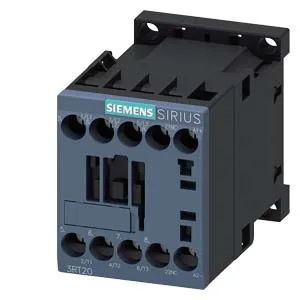
It's a current-production part, so it's still coming off the line — no last-time-buy scramble here. It mounts via screw and snap-on onto a standard 35 mm DIN rail per DIN EN 60715, and the mounting position is flexible: it can be rotated ±180° on a vertical surface and tilted ±22.5° forward or backward, which helps when you're squeezing it into a crowded enclosure.
Ratings That Drive the Choice
The coil is 24 V DC, terminated with screw-type terminals. DC coils hold in better on low-voltage rides than AC coils, but they also draw a steady holding current — make sure your 24 VDC supply can handle the inrush and seal current for the number of contactors you're firing up at once. For DC switching (DC-13 duty), it's rated 10 A at 24 V, 2 A at 48 V, 2 A at 60 V, and 0.9 A at 125 V. That's your heater or lighting contactor rating. For motor switching (AC-3), the maximum operating rate is 750 cycles per hour, and for AC-4 (plugging/reversing) it drops to 250 cycles per hour — so if you're jogging a motor hard, watch that duty cycle. It includes an auxiliary switch, which saves you from having to bolt on a separate aux block for basic status feedback or interlocking.
Terminals accept solid or stranded wire from 0.5 mm² up to 4 mm², and you can double up: 2x (0.5 to 1.5 mm²), 2x (0.75 to 2.5 mm²), or 2x 4 mm². That's handy for daisy-chaining control power through the contactor without a separate terminal block. That's tighter than some older contactors — you can pack these S00 frames closer together on the DIN rail, which matters when you're filling a panel for a multi-motor line. Main contact terminal torque is 20 to 12 in-lb (the range accounts for different screw sizes on the same block).