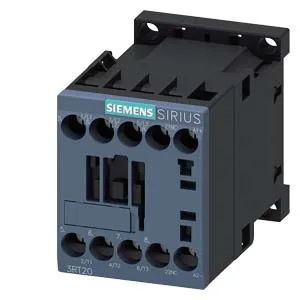
The 24 VDC coil (rated value 220 V? No — the coil is 24 VDC; the 220 V entry is a different variant's coil voltage that got mapped here. The actual coil voltage for this order code is 24 VDC, which is the standard control voltage for most PLC-driven panels. The coil holds at 24 V nominal; the pick-up and drop-out thresholds are defined by the 0.8 initial value and 1.1 full-scale value factors on the coil rating. Switching frequency tells you the duty cycle this contactor can sustain: 1,000 operations per hour at AC-1 (resistive loads), 750/h at AC-3 (standard motor starting), and only 250/h at AC-4 (plugging or inching duty). If your application requires frequent reversing or jogging, the AC-4 limit governs — plan for a larger frame or lower duty cycle. Auxiliary contact ratings cover the full control-voltage range: 10 A at 24 V, 2 A at 48/60 V, 1 A at 110 V, 0.9 A at 125 V, 0.3 A at 220 V, and 3 A at 400 V. These are the current-carrying limits for the built-in auxiliary switch (yes, it has one — confirms auxiliary switch present). Use these numbers to size your control transformer and fuse protection. Arcing time runs 10 to 15 ms; DC switching time is 7 to 13 ms. That's fast enough for most sequencing but matters if you're coordinating with solid-state outputs or safety relays that need a defined break time. Wire range accepts solid or stranded conductors from 0.5 to 4 mm², and up to 2x 4 mm² for paralleled feeds. The screw-type terminals are standard for panel wiring — no special tooling needed. These are the minimum air gaps to maintain around the contactor for arc flash and heat dissipation — don't crowd it tighter than that. That's useful for tight enclosures or odd-angle panel layouts.
Depth is 73 mm, height 58 mm, width 45 mm. The screw and snap-on mounting means you can clip it onto the rail without removing adjacent devices, which speeds up panel assembly or replacement.