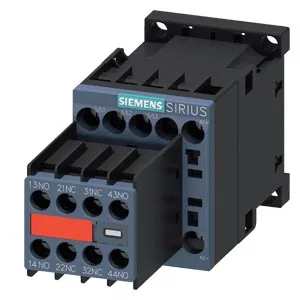
S00 frame — panel density driver
The 3RT2015-1FB44-3MA0: At 45 mm wide, 58 mm tall, and 117 mm deep, it fits tightly on a DIN rail — you can pack more contactors per meter of rail than the larger S0 or S2 frames.
Coil drive and DC switching limits
The magnet coil is rated 24 V DC with screw-type terminals. Pick-up voltage is 0.8 x rated (19.2 V DC), drop-out is 1.1 x rated (26.4 V DC) — so the coil holds in above 26.4 V and drops below 19.2 V. The DC dropout delay is 38 to 65 ms, which matters if you're sequencing contactors off a DC bus with capacitor hold-up. These are the make/break ratings for DC loads — inductive loads will need additional arc suppression at the higher voltages.
Maximum switching rates depend on duty class: 1,000 operations/hour for AC-1 (resistive), 750/h for AC-2 and AC-3 (motor starting), and 250/h for AC-4 (plugging/inching). The AC-3e rating also caps at 750/h. For a conveyor line cycling a motor every 5 seconds, you're at 720/h — within the AC-3 limit, but with no margin for additional inching cycles. Mechanical endurance is 10 million operations typical.
Termination and clearance planning
No auxiliary switch is built in — if you need feedback to a PLC, plan for an external auxiliary contact block that snaps onto the front. In a typical 600 mm wide enclosure, you can fit about 12 of these side-by-side with the 6 mm gap, assuming no other components intrude.
Environmental limits and sourcing
The main contacts are rated for 20 to 12 A — the exact current depends on the duty class and ambient temperature, so derate above 60 °C per the Siemens application manual. Lifecycle stage is current production. Genuine is genuine, same part different passport.