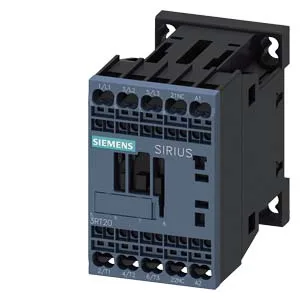
It snaps onto a 35 mm DIN rail per DIN EN 60715 and can be mounted in any orientation within ±180° rotation and ±22.5° tilt on a vertical surface, which simplifies panel layout when space is tight. The coil is 24 VDC, terminated with spring-type terminals — no screwdriver needed for the coil connection, which shaves a few seconds per termination on a build. The main and auxiliary contacts also use spring-clamp terminals accepting 0.5 to 4 mm² solid or stranded wire, or 2x (0.5 to 4 mm²) for paralleled feeds.
Switching frequency limits are what actually govern contactor life in cyclic duty. This contactor is rated for 1,000 cycles per hour at AC-1 (resistive loads), 750 cycles per hour at AC-3 (standard motor starting), and 250 cycles per hour at AC-4 (plugging/inching). If your application runs frequent reversals or jogging, the AC-4 limit is the one to watch — exceed it and the contacts will weld prematurely. The auxiliary contact block is built in and rated for switching at various control voltages: 10 A at 24 V, 2 A at 48/60 V, 1 A at 110 V, 0.9 A at 125 V, 0.3 A at 220 V, and 0.14 A at 440 V. These are the make/break capacities for the auxiliary circuit — useful for PLC inputs or relay coils in the control loop.
That side clearance is tighter than some competitors; if you're packing contactors side-by-side, verify the 6 mm gap is maintained for heat dissipation. The spring-clamp mechanism is the same as the coil terminal — consistent tooling across the board.