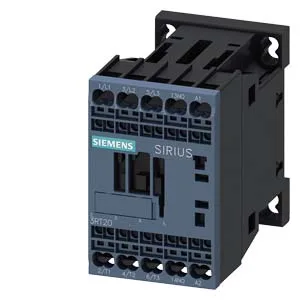
Mounting is via screw or snap-on onto 35 mm DIN rail per DIN EN 60715, and the mounting position allows ±180° rotation on a vertical surface plus ±22.5° tilt forward/backward — useful when panel layout forces an unconventional orientation.
Switching frequency and contact ratings
The maximum switching frequency depends on the duty class: 1000 operations per hour at AC-1 (resistive loads), 750/h at AC-2 and AC-3 (slip-ring and squirrel-cage motors), and 250/h at AC-4 (plugging, inching, reversing). The AC-3e rating matches the AC-3 figure at 750/h. For a continuous-process line cycling a motor once per minute, the AC-3 limit of 750/h leaves headroom; for high-speed indexing at 10 cycles per minute, you'd exceed it. The auxiliary switch (built-in) carries 10 A at 24 V, derating to 2 A at 48 V and 60 V, 1 A at 110 V, 0.9 A at 125 V, 0.3 A at 220 V, and 0.14 A at 440 V. The 400 V rating is 3 A. These are the make/break capacities for the auxiliary contacts — useful for pilot duty or PLC input signals, but not for main power switching.
Termination and environmental limits
Spring-type terminals accept solid or stranded wire from 0.5 to 4 mm², and can take two conductors of the same cross-section (2x 0.5...4 mm²). No screwdriver torque check needed — just strip to the right length and push in. Depth is 73 mm, so it projects less than 75 mm from the DIN rail — fits standard 80 mm deep enclosures.