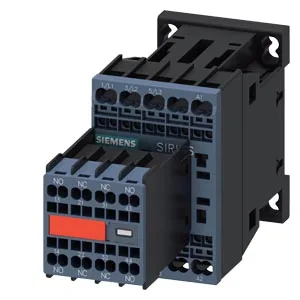
The contactor body is 45 mm wide and 121 mm deep, leaving room for auxiliary contact blocks on the side (no auxiliary switch fitted as shipped). That helps when you're shoehorning it into a crowded panel or a retrofit where the old footprint doesn't align.
Terminals and wiring
The coil magnet uses spring-type terminals — push the wire in, no screw tightening. The main power circuit accepts solid or stranded wire from 0.5 to 4 mm², and you can double up two conductors per terminal (2x 0.5–4 mm²). That's handy for daisy-chaining or paralleling feeds without extra junction blocks. Strip length? Standard 10 mm for spring clamps — keep it consistent to avoid whiskers.
Clearances and environment
The arcing time runs 10–15 ms at AC, so those gaps are real — don't crowd it against a plastic duct. That covers most indoor panel environments, even unheated warehouses.
Switching frequencies and ratings
Mechanical life is typical 30 million operations — the spring terminals and the S00 frame handle that duty cycle well. Maximum switching rates: 1000 cycles/hour at AC-1 (resistive), 750 at AC-2 and AC-3, 250 at AC-4 (heavy inrush). If you're cycling a motor start every few seconds, stay under the AC-3 rate of 750/h. The contactor also carries a 0.75 hp rating at 230 V, and switching currents at various voltages: 6 A at 24 V, 3 A at 400 V, 0.3 A at 220 V, etc.