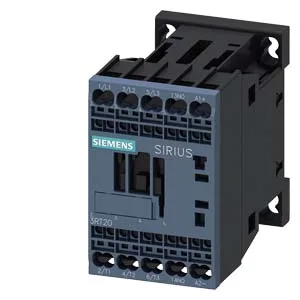
It snaps onto a 35 mm DIN rail per DIN EN 60715 and can be rotated ±180° on a vertical surface or tilted ±22.5°, giving panel builders flexibility in tight enclosures.
The DC-13 switching ratings tell you exactly what inductive loads this contactor can break: 10 A at 24 V, 2 A at 48 V, 2 A at 60 V, 1 A at 110 V, 0.9 A at 125 V, 0.3 A at 220 V, and 3 A at 400 V. That 10 A at 24 VDC is the headline number — it handles solenoid valves, DC brake coils, and small DC motor contactors in that voltage range. The arcing time runs 10 to 15 ms, with a DC switching time of 7 to 13 ms, so the contactor clears fast enough for most control circuits without excessive contact erosion. Switching frequency depends on the duty cycle: 1 000 operations per hour at AC-1 (resistive loads), 750/h at AC-2 and AC-3 (motor starting/running), and 250/h at AC-4 (plugging/inching). If your application jogs or reverses frequently, the AC-4 limit is the one that governs contact life — exceeding it accelerates pitting on the main contacts. Spring-type terminals accept 0.5 to 4 mm² solid or stranded wire (2x 0.5 to 4 mm² per clamp), so you can double-feed a common power rail without a separate terminal block.
The 3RT2015-2BE41 measures 45 mm wide, 70 mm tall, and 73 mm deep — a compact S00 footprint that fits standard 45 mm spacing on DIN-rail panels. That 10 mm forward clearance is critical for the arc chute to vent properly; crowding it against a panel door or wire duct reduces the interrupting capacity.