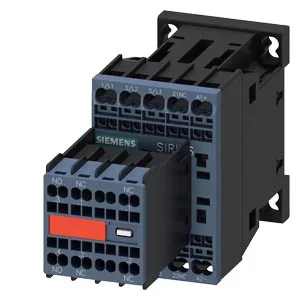
It is a current-production part. The 110 V DC coil (rated value 110 V) with spring-type terminals means this contactor is wired without screw terminals — strip the wire, push it in, done. It accepts solid or stranded conductors from 0.5 to 4 mm², or 2x (0.5 to 4 mm²) for looping through. Mounting is via screw or snap-on onto 35 mm DIN rail per DIN EN 60715, with flexible positioning: +/-180° rotation on a vertical surface, and tilt forward/backward by +/-22.5° on a vertical surface.
The DC coil draws 6 A at 24 V, 2 A at 48 V or 60 V, 1 A at 110 V, 0.9 A at 125 V, and 0.3 A at 220 V — these are the inrush/hold currents the control transformer or DC supply must deliver. The coil operating range has an initial value factor of 0.8 and full-scale value of 1.1, meaning it picks up reliably at 88 V (80% of 110 V) and holds through 121 V. Switching frequency depends on duty: 1 000 operations/hour at AC-1 (resistive loads), 750/h at AC-2 and AC-3 (motor starting/running), and 250/h at AC-4 (plugging/inching). The AC-3e rating also caps at 750/h. For a conveyor running 8 hours at 30 cycles/hour, that's 240 ops — well within limits. DC switching time is 7 to 13 ms. The main contacts are rated for 20 to 12 A. Mechanical endurance is 10 000 000 operations typical — the contactor itself will outlast most applications before the contacts wear. No auxiliary switch is fitted (Auxiliary Switch: No), so plan for an external aux block if feedback is needed.
Environmental and Integration Constraints
Dimensions: 45 mm wide, 70 mm high, 121 mm deep. The HP rating at 230 V is 0.75 hp — useful for small single-phase motor loads in North American panels, though the primary application is three-phase at 400 V.