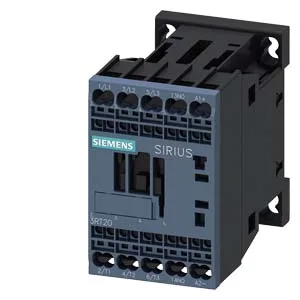
The 3RT2015-2BM41: The coil is rated at 220 V AC, with an operating range of 0.8 to 1.1 times the rated value, meaning it picks up reliably between 176 V and 242 V AC. Coil termination uses spring-type terminals, which eliminates the need for screwdriver torque checks during wiring.
The maximum switching frequency varies by duty class: 1,000 operations per hour for AC-1 (resistive loads), 750 per hour for AC-2 and AC-3 (slip-ring and squirrel-cage motors), and 250 per hour for AC-4 (plugging/inching). The AC-3e rating also sits at 750 per hour. These are the limits for the contactor itself; the actual application cycle must stay within these to avoid exceeding the thermal capacity of the arc chamber. For DC switching, the contactor is rated at 10 A at 24 V, 2 A at 48 V and 60 V, 1 A at 110 V, 0.9 A at 125 V, 0.3 A at 220 V, and 3 A at 400 V. These are the maximum continuous currents for resistive DC loads at the stated voltages; inductive DC loads require derating or external arc suppression.
Wire range for both solid and stranded conductors is 0.5 to 4 mm², and the spring terminals accept two conductors of the same cross-section (2x 0.5 to 4 mm²). This is a standard range for control-circuit wiring in panels.
An auxiliary switch is included on the contactor.