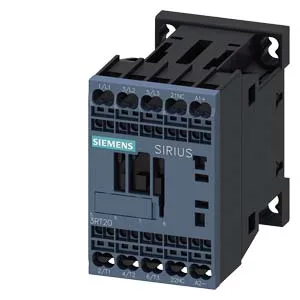
It carries a 48 V DC coil with spring-type terminals, so no screwdriver needed for the coil wiring — just strip and push. The main contacts are rated for 20 A down to 12 A, covering small motors, pumps, conveyors, and lighting banks up to that range. It snaps onto a 35 mm DIN rail per DIN EN 60715, and the mounting position allows ±180° rotation on a vertical surface plus ±22.5° tilt forward/backward, which gives flexibility in tight enclosures.
The headline switching capacity at 24 V DC is 10 A, but at 48 V DC it drops to 2 A — that's the DC arc extinction limit in the S00 frame. At 400 V AC it handles 3 A, and at 230 V AC it's rated 0.75 hp, which lines up with fractional-horsepower motor duty. The AC-3 (motor start/run) switching frequency maxes out at 750 operations per hour, while AC-4 (inching/plugging) is limited to 250 per hour — so if your application does frequent reversing or jogging, stay under that 250/h ceiling or the contactor will overheat. AC-1 resistive loads can cycle at 1000/h. That's standard for S00 contactors, but verify your ferrule sizes if you're using stranded with ferrules — the spring cage works best with stripped solid or ferruled stranded at the right strip length.
No end-of-life notice or last-time-buy date is attached to this variant. If your panel was specified around the 3RT2015-2BF42 (which uses screw-type terminals instead of spring-type), the 2BW42 will drop into the same footprint — same S00 frame, same DIN rail clip, same 73 x 45 x 70 mm envelope. The only difference is the coil connection method, so no rewiring of the main power circuit is needed; just adapt the coil wiring to the spring cage. For a line-down swap, that means you can substitute without re-drilling or re-laying out the panel.
Integration Notes
The auxiliary switch is present on this unit, so you get one NO + one NC for status feedback or interlocking without adding a separate block.