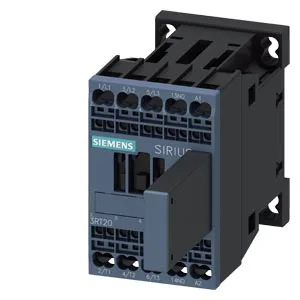
The 3RT2015-2EP01: That narrow width lets you pack more contactors per DIN-rail metre in a control cabinet than the larger S0 or S2 sizes. That 6 mm side gap is the tightest — mind it when packing rows. The coil connection uses spring-type terminals, which speed wiring compared to screw terminals — no re-torquing on thermal cycles.
Auxiliary contact current by voltage
The 24 V rating is the highest — if your control circuit runs at 48 V or 110 V, the current drops sharply. Match the auxiliary contact load to your PLC output or relay coil draw at the actual voltage.
Switching frequency per duty class
Maximum switching rates: 1,000 cycles/hour in AC-1 (resistive loads), 750 cycles/hour in AC-2, AC-3, or AC-3e (motor starting/running), and 250 cycles/hour in AC-4 (plugging/inching). The AC-4 rate is a quarter of the AC-1 rate — if your application involves frequent reversing or jogging, the contactor needs to be sized for that duty or it will overheat. Mechanical endurance is 30 million operations typical — that's the contactor body, not the contacts. Electrical life depends on the switching current and duty; for high-cycle AC-3 applications the contacts will wear before the mechanism does.
We source the 3RT2015-2EP01 to order against your BOM quantity.