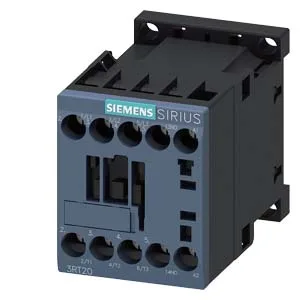
Clearance around it: 10 mm up/forward/down, 6 mm to the side — tight enough for a dense row but leaves room for finger-friendly wiring.
The coil pulls 0.24 A at 50 Hz and 0.25 A at 60 Hz — that's the holding current, not the pick-up surge. The arcing time runs 10 to 15 ms, and the switching frequency ranges from 250 cycles/hour at AC-4 (severe inching/jogging) up to 1,000 cycles/hour at AC-1 (resistive loads). For motor duty (AC-3, AC-3e) you get 750 cycles/hour, which is fine for a conveyor or pump cycling a few times a minute. The auxiliary switch carries 10 A at 24 V, 3 A at 400 V, and derates to 0.14 A at 440 V — that last one is for the control transformer interlock, not the main power path. The 480 V rating at 4.8 A is the highest auxiliary current at that voltage, so if you're feeding a PLC input from this contactor's aux, check the voltage drop over the run.
For BOM freeze or a second-source gate, the closest functional peer in the same S00 frame is the 3RT2015-1AT62, which uses a different coil voltage. If your panel is built around the 1AT62, the 4AN61 will drop into the same DIN footprint and wiring space — just confirm the coil voltage matches your control circuit.
Integration notes
The magnet coil connection uses a ring cable lug — no push-on terminals. Make sure you have the right crimp tool on the van; a loose ring lug on a 24 VDC coil will cause intermittent dropout that's a bear to find. That's the coil and armature, not the power contacts — the electrical life depends on the load and switching frequency. For a conveyor that cycles once a minute, that's about 20 years of service before the coil wears out.