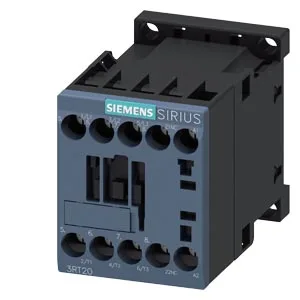
It mounts on 35 mm DIN rail per DIN EN 60715 via screw or snap-on fastening, and the mounting position allows +/-180° rotation on a vertical surface plus +/-22.5° tilt forward and backward — useful when you are packing a tight gland plate and need to orient the contactor to clear the wireway.
The maximum switching frequency depends on the duty category: 1 000 operations per hour at AC-1 (resistive), 750 ops/h at AC-2 and AC-3 (motor starting and running), and 250 ops/h at AC-4 (plugging/inching). If your application cycles a motor on-off every few seconds, the AC-4 ceiling is the binding constraint — exceeding it accelerates contact wear. The arcing time runs 10 to 15 ms at AC, and the make/break time across the main contacts is 4 to 15 ms. That is fast enough for most motor control circuits but worth noting if you are timing a sequence that expects a faster dropout.
Auxiliary contact ratings — what the numbers actually carry
The auxiliary switch is rated for 10 A at 24 V, 2 A at 48 V and 60 V, 1 A at 110 V, 0.9 A at 125 V, 0.3 A at 220 V, and 0.2 A at 440 V. At 400 V it carries 3 A, and at 230 V it is rated 1 hp. These are not the main contact ratings — they are the auxiliary contact limits for signaling or interposing relays. If you are using the auxiliary to drive a PLC input at 24 VDC, the 10 A rating is generous headroom; the 0.2 A at 440 V tells you this contact is not meant for switching a 440 V motor directly.
Integration dimensions and wiring
The envelope is 45 mm wide, 58 mm high, and 73 mm deep — a standard S00 footprint that fits most 35 mm DIN-rail panels without surprises. Solid or stranded wire from 0.5 to 4 mm² is accepted at the screw terminals, and double-wiring is supported: 2x (0.5 to 1.5 mm²), 2x (0.75 to 2.5 mm²), or 2x 4 mm². The 30 000 000 typical mechanical life means the coil and armature should outlast the contacts in most duty cycles.